Get updates from The Developer straight to your inbox Yes, please!




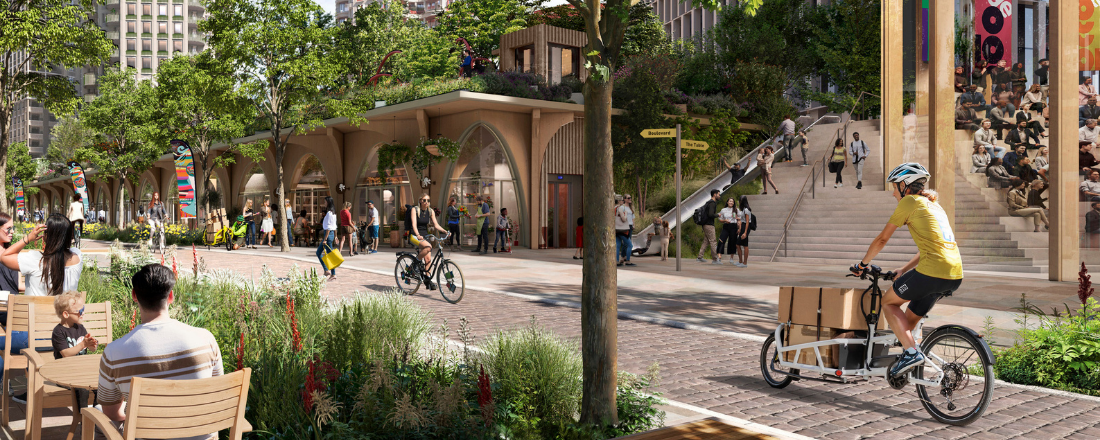
Is my project resilient for the future?
Architecture practice Hawkins\Brown now has a dedicated Foresight team helping developers embrace the unknowns of an increasingly unpredictable future, reports Harriet Saddington
Do you know your unknown unknowns? Foresight is a tool that embraces unknowns and unpredictability to explore multiple possibilities for the future. Distinct from “forecasting” which makes precise projections based on past data, or “insight” which deepens our understanding of the present, foresight prepares us for the landscape of possible uncertainties ahead.
Foresight is an established methodology that has proved valuable across industries for decades. Shell’s scenario-planning in the 1970s prepared it better than its competitors for oil price shocks. Lego anticipated how play would evolve in a digital age. Netflix recognised the shift to streaming before industry consensus. These examples show how exploring multiple futures – rather than assuming a linear trajectory – builds resilience.
Buildings will outlive us, so why is foresight rare in our industry?
Enter leading architectural practice Hawkins\Brown, which established its own foresight service this year.
“The impulse to not rush ahead to think about architectural form, but first think about the strategic brief, is deeply embedded within the DNA of Hawkins\Brown, as is a culture of research,” says Darryl Chen who leads the practice’s new Foresight team.
Back in 2010, Hawkins\Brown answered Corby Council’s brief for a civic centre and council office by combining what was anticipated as two separate buildings into a single “social condenser”: the Corby Cube. Today this building houses one of the most popular libraries in Northamptonshire, against a regional trend of decline, and has a start-up incubator on the top floor (now supporting 25 full-time-equivalent start-up jobs and £2 million per annum in gross value added).
Every foresight project horizon depends on the client’s brief. But typically they surpass immediate political or funding cycles, so beyond five years and sometimes beyond ten.
Research has been a linchpin for Hawkins\Brown since it established a dedicated research team over 12 years ago. Ring-fenced from projects, this team looks across the social sciences, digital design and environmental intelligence. Its foresight model encompasses three dimensions: wide-angle, outside-in and long-term. The team talk about navigating the “cone of uncertainty”, which refers to the fact that the further you look into the future, the wider and more uncertain the possible outcomes.
Every foresight project horizon depends on the client’s brief. But typically they surpass immediate political or funding cycles, so beyond five years and sometimes beyond ten. In the case of a development like Earl’s Court, where the masterplan will be delivered ten to fifteen years in the future, foresight is essential. By the time the development is occupied, the world will have changed. There will likely be more people over the age of 65 than under 18, potentially no combustion engine vehicles on the road and a host of other unknowns.
Hawkins\Brown worked with the Earls Court Development Company (ECDC) on a defined eight-week foresight exercise to help it understand what its blind spots might be across culture, housing, workspace, social infrastructure, technology and urban mobility. This thinking helped establish ambitions for the masterplan that Hawkins\Brown and fellow architecture practice Studio Egret West went on to develop.
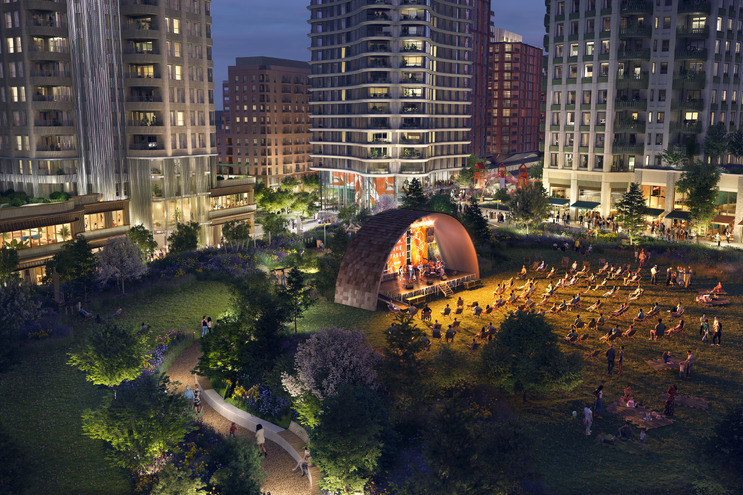
Against the background of Earl’s Court as the site of a former renowned exhibition centre, the foresight study identified the wider trend of disappearing cultural and performance venues in London and the UK.
“The study enabled us to take a long-term view on how cities will function in the decades ahead,” explains ECDC chief executive Rob Heasman. The result is that the proposed masterplan now includes three medium-sized cultural venues intended as a catalyst for public and civic life.
“Is my scheme resilient for the future?” is a common question faced by development directors. Chen points to the way in which his practice can unlock strategies for resilience beyond the conventional architectural service. He is quick to assert that foresight is not fortune-telling. What it does is equip clients with the evidence base for wider thinking that is more rigorous, structured and far-reaching than wilful blue-sky thinking. It helps clients steer decision-making and give them confidence to say: Yes, we have thought widely and robustly about probable futures.
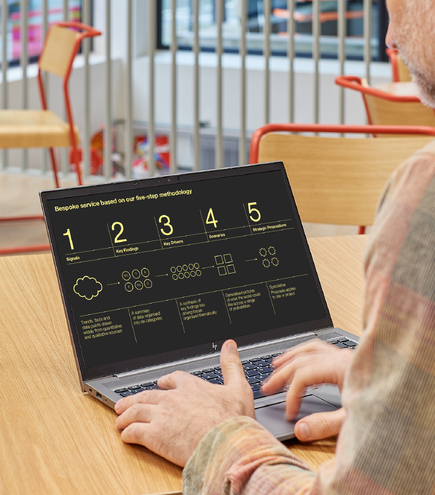
Foresight is geographically driven too, notably in Hawkins\Brown’s work for Landsec at Ewer Street, Bankside. The client was keen to define Bankside as a workplace destination on the map, like Mayfair or the West End. Through Hawkins\Brown’s foresight, new data points emerged that hadn’t been previously considered, including around nightlife and the local economy. The outputs were not so much a complete strategy as a set of trends, scenarios and strategic propositions that bolstered Landsec’s arguments and conviction.
Landsec workplace marketing director Lucy Thomas describes the process as “incredibly collaborative and thought-provoking... The insights will continue to challenge our thinking as we progress through the development.”
The Covid-triggered hybrid-working revolution is a prime example of the impact a lack of foresight can have on real-estate decisions. Many companies were quick to change their setups to embrace working-from-home but now find they underestimated their floor area requirements. Two-thirds of companies say they have undercounted how much desk space they need in their London offices.
Intriguingly, being future resilient doesn’t necessarily mean making buildings as flexible as possible. “Flexibility costs a huge amount of money,” says Hawkins\Brown partner and workplace sector lead Nick Gaskell. “Flexible briefs for life sciences spaces mean that a lot of developments are designed to accommodate a wide range of lab functions. Yet that drives up build costs and drags on viability, so now we’re finding many developments can’t go forward because they’re trying to cater for too many eventualities.”
Contrary to predictions, the demand for “wet labs” is decreasing and the need for computational labs is increasing, and the requirements for each are substantially different. Foresight advocates being particular about what it is you’re being flexible about.
Is this the first wave of architects redefining the profession towards designing systems? Perhaps. Would they be treading on the toes of others already carrying out foresight? Likely not. Business management consultancies and marketing agencies offer similar services in other industries, and ask architects when built environment inputs are required. Hawkins\Brown thought: Why can’t we also offer a future-facing consultancy, and all the more because we are “native” to the built-environment.
“We can offer spatial thinking and a level of granularity that generalist management consultants can’t,” says Chen.
In a time of market uncertainty and economic crisis, many developers (and therefore design teams) are hanging back, waiting for the macroeconomic situation to improve before acting. “Foresight enables future resilience in anticipating risk but also seeking out opportunity,” says Chen. “It’s in economic downturns that you often see the real innovators emerge.”
The hybrid-working revolution is an example of the impact that a lack of foresight can have. Many companies were quick to embrace working from home but now find they underestimated their floor area requirements
Hawkins\Brown’s team includes an economist and social scientist alongside architects, but they also stress their wider network of specialist collaborators: neuroscientists, consumer trend specialists, property data analysts. And of course, AI. The foresight method does involve using AI, but this is “conversationally”, through an iterative back-and-forth between human experts and large language models. The team has instrumentally used these tools in the creation of their Trend Database, a knowledge bank of more than 1,500 data points that maps emergent developments across Hawkins\Brown’s six sectoral specialisms. The human process is important to the foresight outcome, says Chen. “We know that when you bring the client along on the journey to build a body of shared knowledge, they value it and believe in it more by the end,”
So how close are you to telling clients what they should do? I ask. “We get to the doorstep of that,” says Chen. “We form scenarios and then draw out strategic propositions from them. And those are generally spatial across the wide range of factors that manifest in the built environment.” It’s not systems thinking but it’s systems-like thought. “We’re looking at consumer trends, environmental projections, weak signals … and because we do that across various fields, we start to see the interrelationships between things. We’re looking at how interdependencies might inflect current decision-making; we’re not saying you’ve got to redesign the whole system.”
Who else is foresight for? “That’s the exciting part,” says Chen. “We’re realising that a lot of clients can deal with a little bit more RIBA Stage 0 in their coffee.” Rather than knee-jerk reactions based on current indicators, this is an opportunity to think more widely and creatively about the nature of wider drivers of change. Foresight maps futures, you choose your route to resilience.
For more information or to arrange an exploratory chat, contact darrylchen@hawkinsbrown.com
Discover: www.hawkinsbrown.com
If you love what we do, support us
Ask your organisation to become a member, buy tickets to our events or support us on Patreon
Sign up to our newsletter
Get updates from The Developer straight to your inbox
Thanks to our organisation members
© Festival of Place - Tweak Ltd., 124 City Road, London, EC1V 2NX. Tel: 020 3326 7238