Get updates from The Developer straight to your inbox Yes, please!




The Sutton Estate, Royal Borough of Kensington and Chelsea for Clarion Housing Group with HTA Design, Civic and Durkan
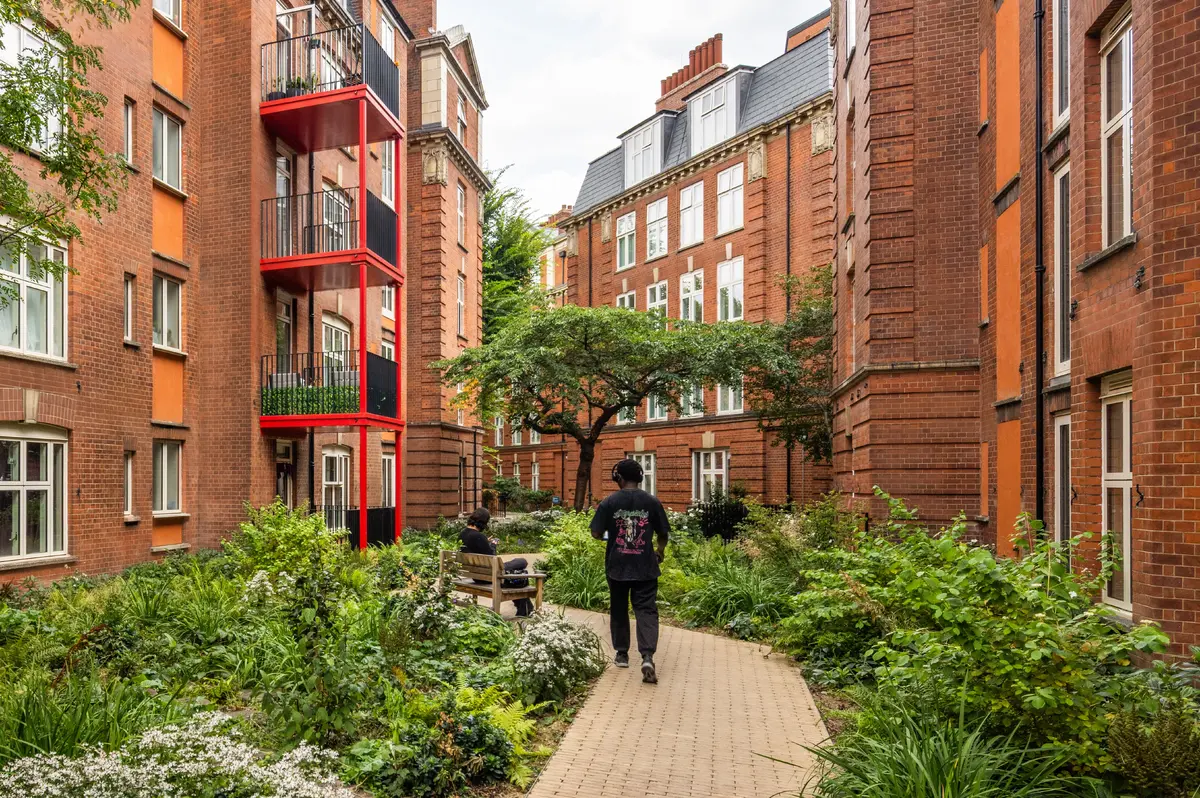
The Sutton Estate, Royal Borough of Kensington and Chelsea for Clarion Housing Group with HTA Design, Civic and Durkan
Sutton Estate, Chelsea, one of the UK’;s earliest social housing developments, has been remodelled and refurbished to continue William Sutton’s vision of providing high-quality homes for those in need. Designed with local residents, the 81 affordable and future ready homes are served by ground source heat pumps, reducing carbon emissions and energy consumption. Enhancements to green spaces include rain gardens and SUDs, wildlife-friendly areas, a play trail, and improved amenities, resulting in Building with Nature accreditation – the first in an urban setting.
Describe the context of this project, its neighbourhood and people.
The Sutton Estate in Chelsea, built in 1913, stands as a pioneering social housing development, realising William Sutton’s vision to provide quality homes for those in need. Located in a conservation area, the whole estate comprises 462 affordable rented homes in 15 five-storey blocks. Sutton Estate’s character is defined by regular geometry, traditional materials, and fine Edwardian Baroque architectural detailing. The Sutton Estate is a vital oasis of social housing. Located in Chelsea, amongst some of the most expensive properties in London, the four blocks had lain vacant since 2016. The original studios and one-bedroom flats which provided homes for working families over many years no longer met modern energy, spatial and accessible standards. Clarion Housing Group’s decision to retain and modernise, rather than demolish, was welcomed by the residents living there and the local community. This approach not only retained significant embodied carbon, supporting environmental goals, but also ensured the transformation effectively met evolving community needs, successfully balancing historic integrity with current housing standards. The refurbished blocks now provide 81 future-ready, 100% affordable social rented homes, including a mix of one- to four-bedroom flats designed to match the needs of local residents. Adaptable and accessible homes for all ages, has been achieved with eight fully accessible ground floor flats and lifts in every block. Complementing these are new private balconies and improved landscaped areas, such as a central community garden, enhancing social connection and amenity for new as well as existing residents of the Sutton Estate.
Describe the intervention you’ve made including its purpose and motivation. Please explain the governance of the project, describing its viability and any consultation and community engagement undertaken.
The main aims were to retain the historic fabric of the building while enabling a multi-generational, inclusive environment. The resulting affordable homes are energy efficient, spacious and fully accessible by new lifts. The scheme has been brought into the 21st century with heat loss reduction measures, increased room size and improved natural light. Internal breathable wood fibre insulation conserves the original brickwork while enhancing thermal performance. Structural intervention was minimised by retaining loadbearing walls and most chimney breasts; only four chimney stacks were removed, with fireplaces enclosed and ventilated. The compact urban site has limited external space, so we installed ground-source heat pumps between the blocks and removed redundant stores to create a shared landscaped area for all residents. We secured complex planning consent in a conservation area in January 2021, showing no net loss of affordable floor space. Investment in a major refurbishment is not immediately viable, but demolition of this historic asset wasn’t an option. Taking a long-term view, the benefits in providing high quality homes for the next 100 years demonstrates value over time, alternative to demolition. Extensive consultation and community engagement involved existing residents from the outset. A comprehensive programme included Zoom workshops, estate walkabouts, and an open air ‘cinema’ during the COVID-19 pandemic. Older residents were supported and all residents together with the Residents’ Steering Group were involved. This direct dialogue ensured resident feedback informed both internal layouts and outdoor spaces, such as garden courts and the sunken garden, genuinely reflecting community needs and preferences.
How does this project make use of an existing structure, place or building in a creative way? Is it innovative? How will this project continue to evolve or enable future flexibility and adaptation? Have you considered its resilience?
The project innovatively integrated E.C.P. Monson’s original intent, guiding repairs and thoughtful additions that preserve the estate’s character. We updated the external appearance, notably resigning the windows to improve performance and maintenance across the whole estate. Space for recessed balconies, painted in red which was popular in Edwardian times, was achieved by repurposing original privvy toilets, providing private outdoor space without compromising façade formality. New elements, including doors and renewed roofs/dormers, were carefully matched to the historic palette and original design. Salvaged bricks from internal demolitions were reused for repairs. Lift shafts were strategically placed in corners formed by existing walls, with new steelwork supporting the remaining sides. The most complex element was constructing the lift pit. Initial designs proposed underpinning, but further detailed investigation revealed that excavation depths were only slightly below existing foundations in all but one location. This allowed us to revise the design, preserve the historic fabric and avoid underpinning altogether. For future flexibility and resilience, extensive research into sustainable refurbishment addressed heritage significance, upgrading fabric and layouts to meet modern standards, locking in carbon; to avoid rebuilding emissions. Working with the Durkan as the contractor, we installed an innovative Kensa ground source heat pump system, using 27 boreholes drilled to 180m to deliver zero on-site emissions and low-carbon heating, proving feasibility for dense urban sites and historic buildings. SuDS were integrated via raingardens, attenuating surface water without extensive buried infrastructure. Hardstanding was replaced with green spaces meeting Building with Nature standards for wellbeing and wildlife.
Sign up to our newsletter
Get updates from The Developer straight to your inbox
Thanks to our organisation members
© Festival of Place - Tweak Ltd., 124 City Road, London, EC1V 2NX. Tel: 020 3326 7238