Get updates from The Developer straight to your inbox Yes, please!




The Arches Leytonstone, London Borough of Waltham Forest for Forte Green Ltd with ADD, BD Landscape and Kronen
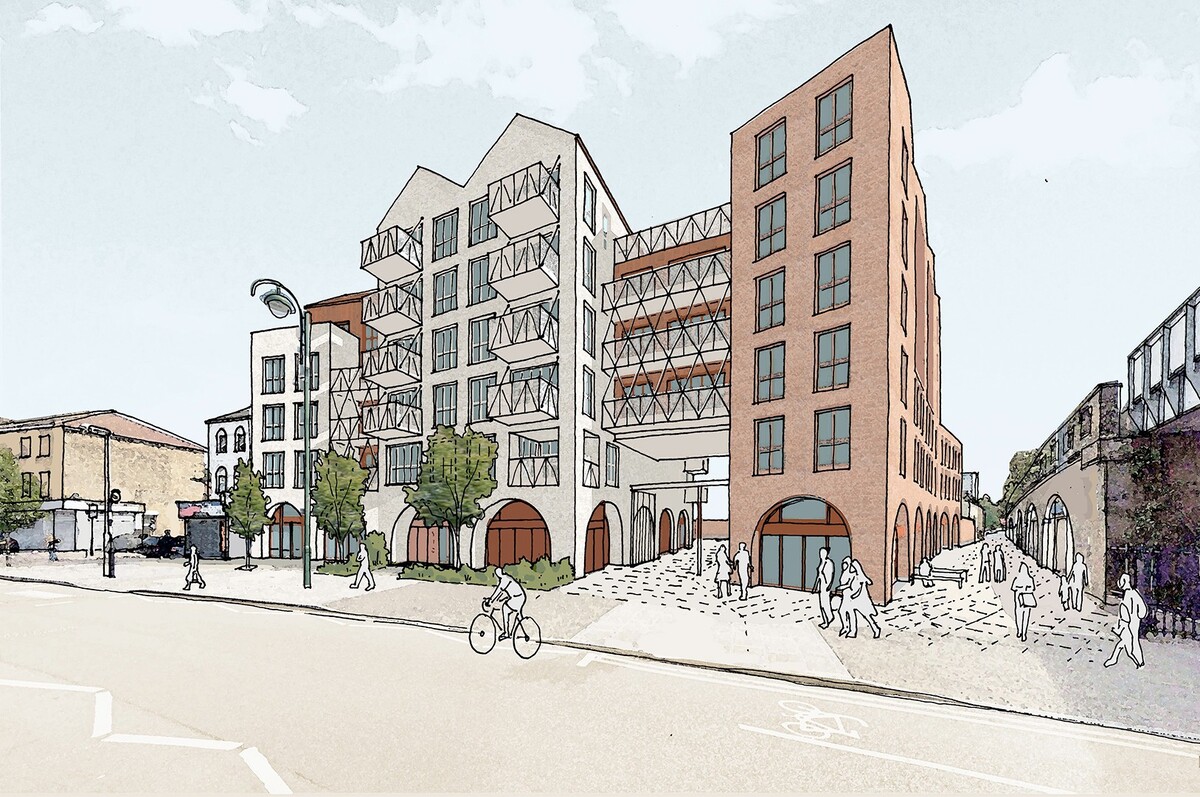
The Arches Leytonstone, London Borough of Waltham Forest for Forte Green Ltd with ADD, BD Landscape and Kronen
A new mixed-use destination for Leytonstone, located opposite the train station, replacing a disused builders yard.
The proposals cluster flexible, affordable, workspaces around a central yard, and along the existing railway edge, activating the street and creating a new pedestrian walkway known as Arch Walk. These units will attract independent businesses, artists and makers. 39 flats are located above.
The building is designed with a bold and characterful form, a celebration of the site’s industrial past, with pitched roofs, flying bridges, and intricate metalwork.
Describe the context of this project, its neighbourhood and people.
The site is located on the southernmost tip of the defined ‘Town Centre’, marking the entry to central Leytonstone. It is designated as a Locally Significant Industrial site, meaning its current employment use is protected, and proposals must re-provide light industrial floorspace alongside any residential development. Leytonstone High Road was the historic route linking Epping Forest to central London. As a result, the road is characterised by Victorian terraces with commercial activities at ground floor to capture passing trade, with living accommodation above. The footprint of the site is relatively constrained by its immediate context, bound by the railway to the south (a raised viaduct with arches below) and the High Road to the west. Directly to the north, against the site boundary, is a three storey Victorian terraced building, which was once part of a group of three but which now stands alone. To the north and east are runs of modest Victorian terraced houses, whose gardens back onto the site. The building works hard to knit itself into this context, responding to each of the different boundary conditions, stepping down towards the Victorian buildings, and up towards the railway. Leytonstone itself has a rich culture and unique feel, with beautiful historic buildings and a creative edge. It has largely avoided much of the over-gentrification of other parts of east London. The area attracts a diverse and vibrant community, and is full of independent shops, makers and artists, something we want to continue to support in these proposals.
Please describe your approach to this future place and its mix of uses. How will it function as a vibrant place? How does it knit into, and serve the needs of, the wider area?
The site is currently under-used and an eyesore, a builders yard and offices, with no active street presence. This sustainable and well-connected location, opposite the train station and marking the entrance to Leytonstone town centre, is the perfect place for a new community to grow and thrive. The proposals carefully co-locate residential use alongside light industrial and office units, in a way that both uses can support each other. Planning policy protects the industrial employment usage of the site, but rather than seeing this as a constraint, we see it as an opportunity for something different to be provided, different to the usual high street mobile phone shops, betting shops etc. Here, the light industrial use designation, and the provision of 12 small, flexible and affordable units (rather than one or two larger warehouses) will attract makers, artists, young entrepreneurs and creatives. A true creative hub can grow here, which will serve the wider area and become a destination, and well as supporting and nurturing a community of residents and creatives on site. The current railway arches running along the southern boundary of the site are mostly used for storage, with blank, inactive facades. The alleyway they front is a useful cut through to the station for local residents, but it is poorly lit and feels unsafe. By mirroring these arches in the new development opposite, and creating a vibrant new commercial frontage, activity can spill across the alleyway, and a new pedestrian route, known as Arch Walk, is created.
Please explain the governance of the project, such as its viability, purpose, motivation and any consultation and community engagement undertaken.
The developer of this project grew up in Waltham Forest close to Leytonstone, and still lives locally. When this site came on the market, he jumped at the chance to make a positive change to the area. The project has taken a year and a half to get to this stage, with the designs ready for submission to the planners. Over that time we have got to know many of the neighbours, the nearby local businesses, the local councillors and the wider Leytonstone community. We have hosted multiple public consultation sessions and opened up a website for public comments (see selection attached). By working closely with, and listening to, the local community, we know they do not want mass gentrification, though there is a desire for improvement, bringing life and vibrancy to the area. To function as a true creative hub, the commercial units must be affordable, to attract the local small businesses which will make this development thrive. The site needs to incorporate industrial use due to its planning designation, but rather than provide a large warehouse (a builders merchants, or a large storage unit, for example) these proposals seek to provide smaller, flexible, workspaces for makers, artists, creatives and start-ups. By clustering these units together, and wrapping them back around into the site and along the railway edge (rather than a single string of high street units) a new destination is formed, where businesses can grow and thrive together.
Sign up to our newsletter
Get updates from The Developer straight to your inbox
Thanks to our organisation members
© Festival of Place - Tweak Ltd., 124 City Road, London, EC1V 2NX. Tel: 020 3326 7238