Get updates from The Developer straight to your inbox Yes, please!




Sunniside Place Strategy, Sunderland for Sunderland City Council with TOWN and Create Street
Sunniside Place Strategy, Sunderland for Sunderland City Council with TOWN and Create Street
The Sunniside Place Strategy is a strategy and 10-year action plan to repopulate and reactivate Sunniside. Taking an ‘all hands-on deck’ partnership approach to overcoming a long period of complex challenges and market failure, the project is creating a liveable city neighbourhood within Sunderland’s City Centre that nurtures diversity, enterprise and creativity. As the first new homes are emerging, businesses move on to the high street, and people are describing themselves as Sunnisiders, this strategic approach from Sunderland Council and partners is proving effective.
Describe the context of the strategy, research or policy. What need does it serve? What questions does it answer? What is its social and environmental impact?
The Sunniside Place Strategy (2023) is a 10-year strategy and action plan to repopulate and revitalise Sunniside, a key neighbourhood within Sunderland City Centre. At publication, the area was widely perceived as unsafe and declining, with only 400 residents, low footfall, high vacancy and turnover rates, and buildings visibly derelict or shuttered to protect against crime. Much of the east of Sunniside was given over to light industry, storage or empty property (around 70%), while poor-quality supported housing contributed to negative perceptions and instability. Years of unsuccessful regeneration had left deep frustration within the community, particularly among independent businesses and creative organisations drawn to the area during the 2000s. Data showed footfall across most of Sunniside was almost non-existent, making investment and business survival extremely difficult. Anti-social behaviour and fear were major barriers to change.
Yet opportunities were emerging: successful heritage-led renewal with Historic England, an emerging creative sector, and land assembled for a major housing scheme capable of catalysing sustained regeneration. The strategy’s purpose was to bring proactive management to critical issues, rebuild confidence and enable repopulation through coordinated investment and a stewardship model that gives agency to local people.
The ambition is social and environmental transformation: creating a liveable neighbourhood that supports happy, healthy lives and enables businesses to thrive, reducing crime, increasing footfall, reactivating streets and public spaces, improving movement connections and restoring historic buildings to sustainable use. The environmental impact lies in intensifying the use of existing assets, reducing dereliction and supporting a lower-carbon urban community.
Did you consult key stakeholders or the community in the creation of this document or policy? How did you select participants? Was the final strategy shared with the community? Is this engagement ongoing?
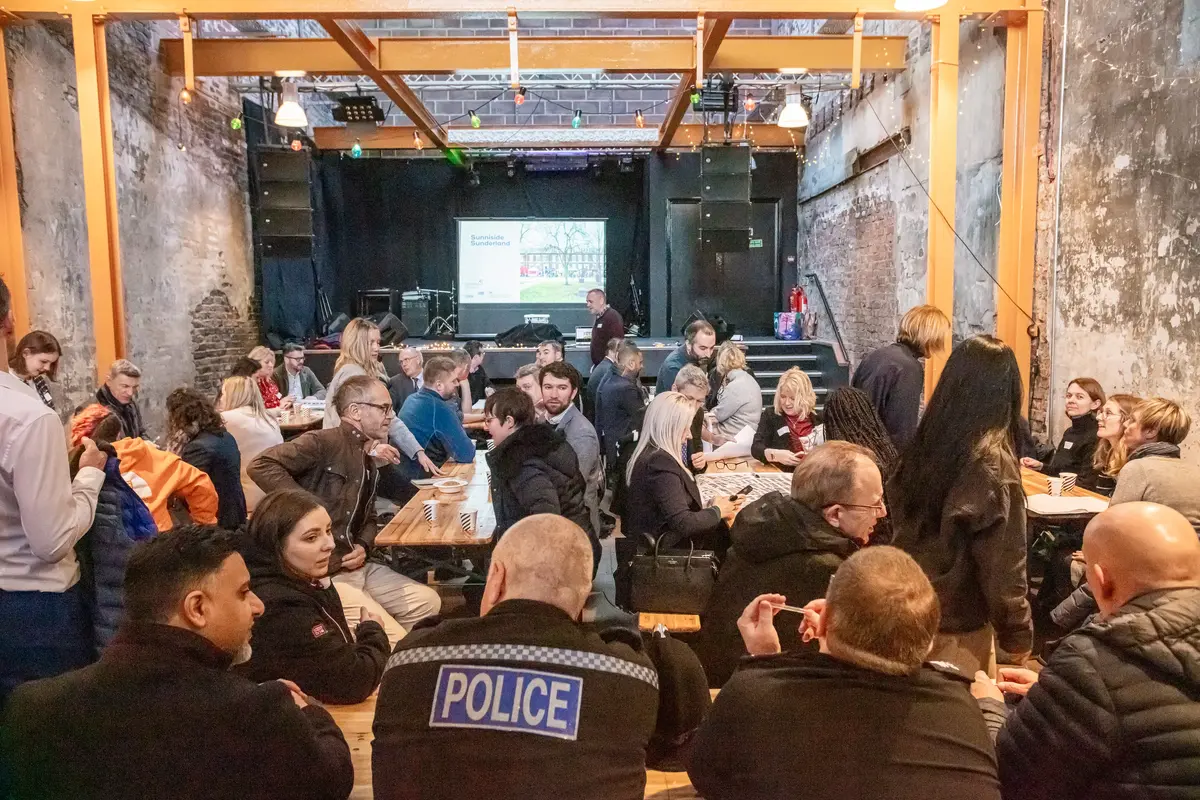
Engagement with stakeholders was central to the development of the strategy and is a defining reason for its effectiveness. From the outset, Sunderland City Council briefed a place- and people-first approach, seeking meaningful participation rather than symbolic consultation. Stakeholders were recruited through door-knocking, direct approaches, referrals within the community, public walkabouts, newsletter drops, lamppost signage and social media. Engagement occurred in a context of frustration, fear and scepticism; however, participation has continued to grow as visible change and early actions are increasing confidence.
The Council took an “open address book” approach across service departments and partner agencies, allowing TOWN and Create Streets to genuinely ask: What is not working? What will it take to solve it? The process evolved through stakeholder-wide workshops into three focused working groups. Priorities emerged directly from local input, determining what felt urgent and important.
Actions began before the strategy was published: the new safety partnership replaced emergency private security officers; a programme of events activated Sunniside Gardens; and creative engagement supported the creative community to begin to shift perceptions.
The final strategy was publicly shared through the project website but most meaningfully through ongoing relationships between regeneration professionals on the ground and local stakeholders. Progress and successes are shared through social media, on Instagram @sunniside_sunderland. Engagement continues as part of delivery and informs development of a future stewardship model that will transition leadership to the community over time. This ensures actions remain rooted in lived experience and enables long-term capacity-building.
How will the research or strategy be taken forward or implemented? Please describe any accountability, metrics or enforcement built into the process to encourage meaningful change.
The Sunniside Place Strategy is implemented through a phased Action Plan structured around five workstreams: developing a strong sense of place and purpose, creating a safe neighbourhood, activating the neighbourhood, intensifying uses and building the population, and coordinating change through cooperative stewardship. Actions are structured across 6-month, 3-year, 6-year and 10-year phases with clear ownership, funding needs and prioritisation based on impact, fundability and deliverability. The action plan is a living document reviewed and updated as circumstances change.
Meaningful accountability is built through measurable indicators designed to track progress against core success objectives. These include increases in residential population and business survival rates, space activated and vacancies reduced, increased footfall and dwell time, reductions in anti-social behaviour and crime reports, and reduced numbers of beds in unregulated supported accommodation. These metrics were selected to reflect complex challenges while giving stakeholders confidence that change is real and measurable.
Monitoring includes key performance indicators around investment value, perceptions of safety and confidence, and survey responses from residents, visitors and traders. Regular reporting to Sunderland City Council’s scrutiny committee ensures democratic oversight and transparency. A public annual review reports outcomes and progress (the 2024–25 review followed the first year of delivery).
Partnership remains core to implementation. While initial leadership comes from the Council and regeneration professionals embedded in Sunniside, responsibility will transition to a community-led stewardship model as capacity grows, ensuring the long-term sustainability of change beyond the ten-year programme.
Sign up to our newsletter
Get updates from The Developer straight to your inbox
Thanks to our organisation members
© Festival of Place - Tweak Ltd., 124 City Road, London, EC1V 2NX. Tel: 020 3326 7238