Get updates from The Developer straight to your inbox Yes, please!




Mayfield - Phase One, Manchester, The Mayfield Partnership (Landsec, Manchester City Council, Transport for Greater Manchester and Platform4) with Studio Egret West, Morris+Company, Civic, Bennetts Associates and shedkm
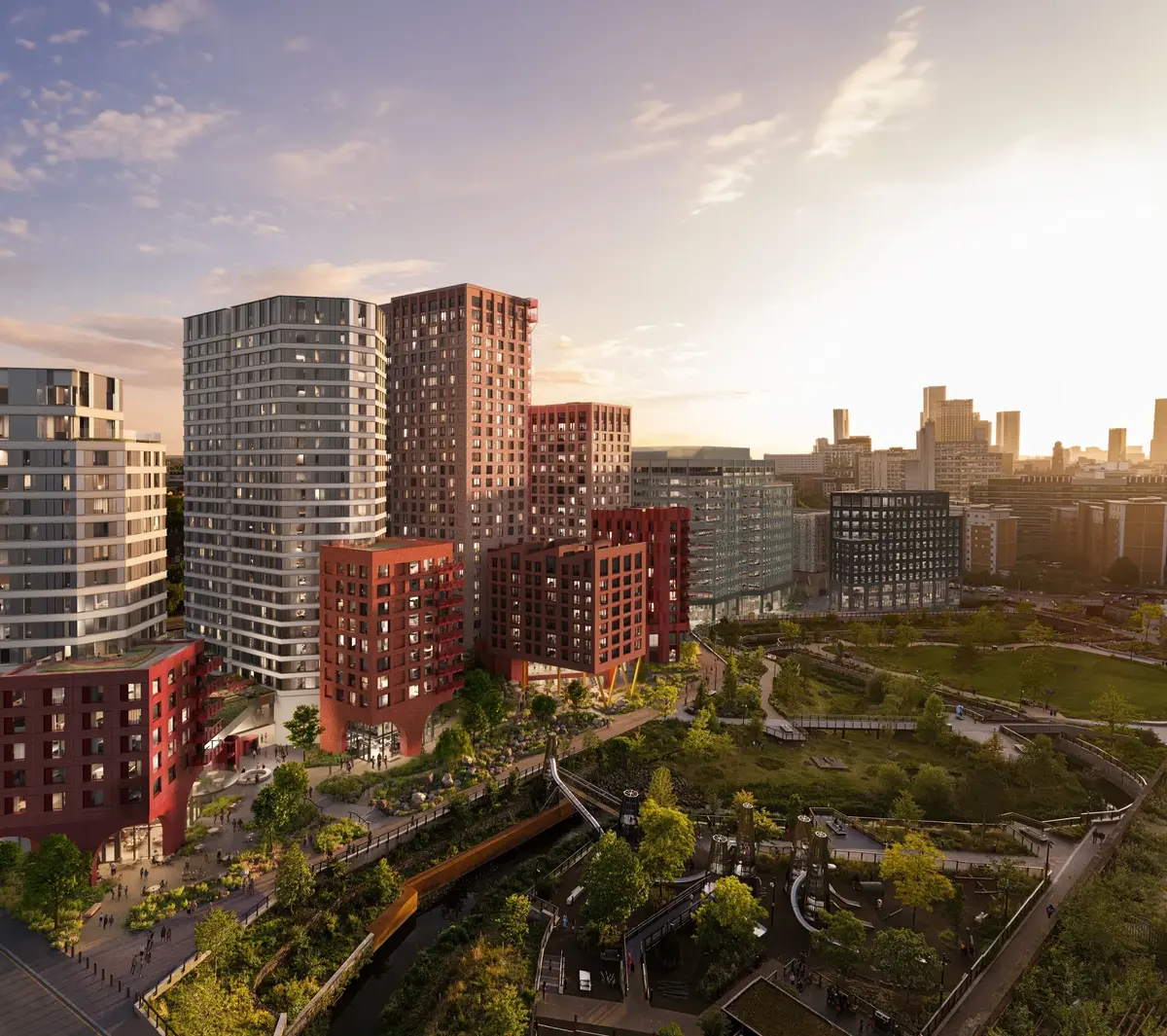
Mayfield - Phase One, Manchester, The Mayfield Partnership (Landsec, Manchester City Council, Transport for Greater Manchester and Platform4) with Studio Egret West, Morris+Company, Civic, Bennetts Associates and shedkm
Mayfield is a place like no other, providing real, positive economic, environmental and social impact from within Manchester City Centre. Spanning 24 acres of previously derelict brownfield land next to Manchester’s Piccadilly Station, the Mayfield masterplan represents the reintegration of a lost city district into a green, connected place where thousands of people will live and work, and millions will visit.
Describe the context of this project and the point it has reached in its development. Who was there in this place before development, where have they gone, who is there now and who will be there in future? When is the project expected to be complete?
Mayfield is a place that has a story dating all the way back to the 1700s. Originally a meadow with a river running through, it later became a vital cog in Manchester’s Cottonopolis – the engine room of the Industrial Revolution – when entrepreneur Thomas Hoyle established a globally significant printworks on the site.
As other parts of the city thrived and grew, Mayfield was left behind. Largely locked off and concreted over, the site which was once world known as a place of great innovation, was forgotten.
The rebirth story began in 2016 when Landsec was selected as the development partner by Manchester City Council, TfGM and LCR (now Platform4) to form the Mayfield Partnership.
The first big move in 2019 was the creation of a cultural venue, Depot Mayfield, with the capacity to host 10,000 person electronic music events. Within it, a new food and drink venue, Freight Island, would also open and go on to support 50+ businesses creating 1,200 jobs.
Despite the challenges the pandemic posed, the creation of Mayfield Park forged on with the support of a £23m Build Back Better government grant. The first piece of the park opened in 2022.
Today, the park is thriving, complemented by Depot Mayfield’s rich cultural strategy hosting music, fashion and the RHS Urban Show in 2024. Mayfield is firmly in motion with completion of the first residential and office phases is expected by 2028, with the full masterplan delivered by the early 2030s.
How are you seeking to foster community, welcome visitors and attract tenants? How are you responding to changing demographics, behaviour, market context, policy, transport habits and the climate crisis since winning planning?
The next generation of tenants is looking for workspaces which represent more than purely an office space. Mayfield offers a place for fostering togetherness, higher levels of productivity, improved levels of wellbeing, and for the first time in Manchester’s modern history the opportunity to work in a park in Manchester. This will be a tantalising opportunity for businesses to level-up their offer to talent which can have a direct link to improved levels of performance for businesses.
Mayfield’s adjacency to Manchester Piccadilly ensures sustainable connectivity. Threshold works are improving station access, while a future multi-modal hub will integrate bus, tram, train and cycling, including one of Manchester’s largest cycle hubs with space for 400+ bikes.
The scheme adapts to shifting demographics and market trends: flexible workspaces, homes designed for diverse lifestyles, and cultural programming that reflects Manchester’s identity. Sustainability underpins every decision, from embodied carbon targets to active travel infrastructure, making Mayfield a blueprint for resilient urban regeneration.
Please explain the governance of the project, such as its viability, purpose, motivation and any consultation and community engagement undertaken.
Mayfield is a prime example of collaborative governance through a public-private partnership comprising Landsec, Manchester City Council, Transport for Greater Manchester, and LCR (Platform4). This structure was established in 2016 to unlock one of Manchester’s most strategic brownfield sites and deliver a £1.4bn regeneration scheme.
The partnership’s purpose is clear: to create a sustainable, mixed-use, green neighbourhood that meets Manchester’s housing and employment needs while preserving its industrial heritage. The Strategic Regeneration Framework, adopted in 2018, guides delivery of up to 1,500–1,700 homes, 2.3m sq ft of workspace, and 13 acres of public realm, anchored by Mayfield Park.
Community engagement has been integral from the outset. Public consultations shaped the SRF and continue to inform design, including the 2024 consultation for 879 homes and a 40% park expansion, which featured exhibitions, drop-in sessions, and an online platform for feedback. Local schools were invited to planting days in the park, and cultural programming at Depot Mayfield and Freight Island has embedded the site in Manchester’s social fabric.
Viability is underpinned by phased delivery and long-term stewardship. Long-term stewardship plans will ensure the park and public spaces remain accessible and well-maintained, embedding Mayfield as a lasting asset for the city.
Sign up to our newsletter
Get updates from The Developer straight to your inbox
Thanks to our organisation members
© Festival of Place - Tweak Ltd., 124 City Road, London, EC1V 2NX. Tel: 020 3326 7238