Get updates from The Developer straight to your inbox Yes, please!




Manchester Metropolitan University, Science and Engineering, Manchester for Manchester Metropolitan University with BDP, 5Plus Architects, Curtins, Hoare Lea, Turley and Gardiner & Theobald
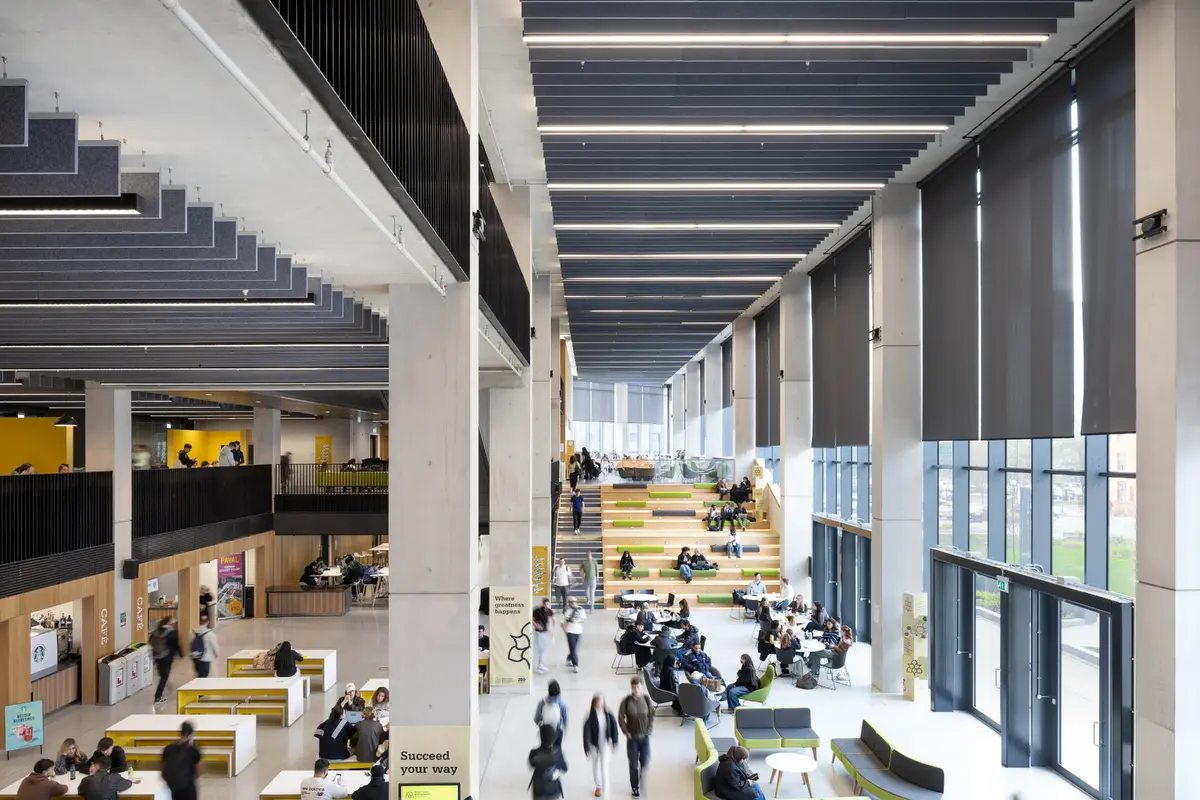
Manchester Metropolitan University, Science and Engineering, Manchester for Manchester Metropolitan University with BDP, 5Plus Architects, Curtins, Hoare Lea, Turley and Gardiner & Theobald
Arising from BDP’s rationalisation of the University’s Estate Strategy and Masterplan in 2014, Manchester Metropolitan University appointed BDP to lead the improvement and expansion proposals of their Faculty of Science and Engineering. Completed in Summer 2024, the Science and Engineering project pairs the delivery of highly sophisticated, new-build teaching and research facilities, with a carefully strategised refurbishment package of existing laboratories and workshops in adjacent buildings.
Describe the social and environmental context of this project, its neighbourhood and people. What is the purpose of the building? How does this building make an impact in its community?
The Science and Engineering Building creates a key threshold between the University and the city, forming a new gateway that welcomes students, staff, visitors, and the wider community. Positioned on a prominent urban site, the project reconnects the campus with its surrounding neighbourhood, creating a more open civic frontage and strengthening the University’s relationship within the city. The landscape and public realm invite movement through the site, encouraging passers-by to engage with the institution and the activity within. Conceived as a flagship centre for teaching and research, the building’s purpose is to celebrate science and make it visible. Transparent façades, open circulation routes, and views into laboratories showcase the faculty’s work, transforming the building into an accessible beacon of innovation.
Its environmental strategy is rooted in a low-carbon, comfort-driven approach. Exposed thermal mass, natural material palettes, and optimised daylighting reduce embodied and operational energy demands while creating bright, calm interior environments. High-efficiency lighting and zoned controls further minimise energy use, ensuring resilient long-term performance. The social impact of the building is felt most strongly in the way it has reshaped the student experience. Designed around WELL principles, its inclusive spaces, from quiet nooks to collaborative lounges, support diverse learning styles and promote wellbeing. The building has become a “sticky” destination where students choose to study, socialise, and stay longer on campus. By opening the University to the city and providing a healthy, inspiring environment for learning and research, the building enhances civic identity and contributes meaningfully to its community.
Is the project innovative or creative in its design or purpose? What does it do well in terms of serving its people?
Innovation in both design and purpose underpins the Science and Engineering Building, redefining how the University delivers flexible, future-ready STEM education. The most significant advancement is the multi-functional super-lab, an adaptable, flat-floored facility that accommodates over 200 students from different disciplines simultaneously. Its reconfigurable benching and integrated digital infrastructure enable subjects to be taught side by side, reducing repeat teaching to just 25% of the previous timetable. This gives academics significantly more time to focus on research, strengthening the University’s capacity for high-impact discovery. As one senior lecturer noted, “The super-lab has transformed our teaching model and freed space for deeper research engagement.”
Equally transformative are the building’s terraced atria: three vertically connected social landscapes that link teaching, research, and collaboration zones. These spaces deliberately foster informal encounters between disciplines, an essential driver of scientific innovation. Many of the world’s major breakthroughs stem from cross-over thinking, where ideas from one field unlock advances in another. By dissolving physical and psychological boundaries, the atria actively cultivate this interdisciplinary culture, offering settings for exhibitions, group work, and chance dialogue.
Together, these innovations create a building that serves its people exceptionally well. Students benefit from clearer, more connected learning pathways; academics gain time and flexibility; and researchers operate within an environment designed to spark new lines of inquiry. While primarily an academic building, its welcoming public edges and transparent interiors ensure it remains a considerate neighbour, contributing positively to its immediate surroundings.
This project sets a new benchmark for adaptable, people-centred science education.
Please describe the programme of the building, and how its design serves this use. Please also explain whether the future viability of this use has been considered. How might the building be repurposed to other uses?
The Science and Engineering Building brings together a diverse programme of social, teaching, research, and workplace functions under one roof. Its layout interweaves social spaces, self-directed learning zones, seminar rooms, dining areas, and a mix of teaching and research laboratories, including the University’s flagship super-lab. These are complemented by open collaboration areas and staff workspaces, creating a seamless environment where learning, experimentation, and discussion occur side by side.
The design serves this programme by promoting visibility, adaptability, and connection. Terraced atria draw daylight deep into the plan and create a central social spine, while glazed laboratories and seminar rooms place teaching and research on display, encouraging engagement and improving supervision. Breakout spaces punctuate circulation routes to support informal learning, and technology-enabled seminar rooms and flexible planning ensure the building can host workshops, exhibitions, and cross-faculty events as needed.
Future viability was integral to the design. The laboratories are conceived as a “kit of parts”, allowing one scientific discipline to be reconfigured for another with minimal intervention. The super-lab’s flat-floor design and modular benching make it inherently adaptable to evolving pedagogical and research needs. Generous floor-to-ceiling heights, a robust concrete frame, and a long-span structural grid provide long-term flexibility, allowing the building to absorb significant changes in use over time.
Like the Victorian warehouses that have been repeatedly reinvented while retaining their core structure, the building is designed for longevity and transformation. Its clear spatial logic and durable frame ensure it can be repurposed for future academic, commercial, or community needs.
Gallery

Sign up to our newsletter
Get updates from The Developer straight to your inbox
Thanks to our organisation members
© Festival of Place - Tweak Ltd., 124 City Road, London, EC1V 2NX. Tel: 020 3326 7238