Get updates from The Developer straight to your inbox Yes, please!




Cockpit Deptford, London Borough of Lewisham for Cockpit with Cooke Fawcett Architects, Planning Lab, Momentum, Max Fordham LLP, New Stages and Gardiner & Theobald
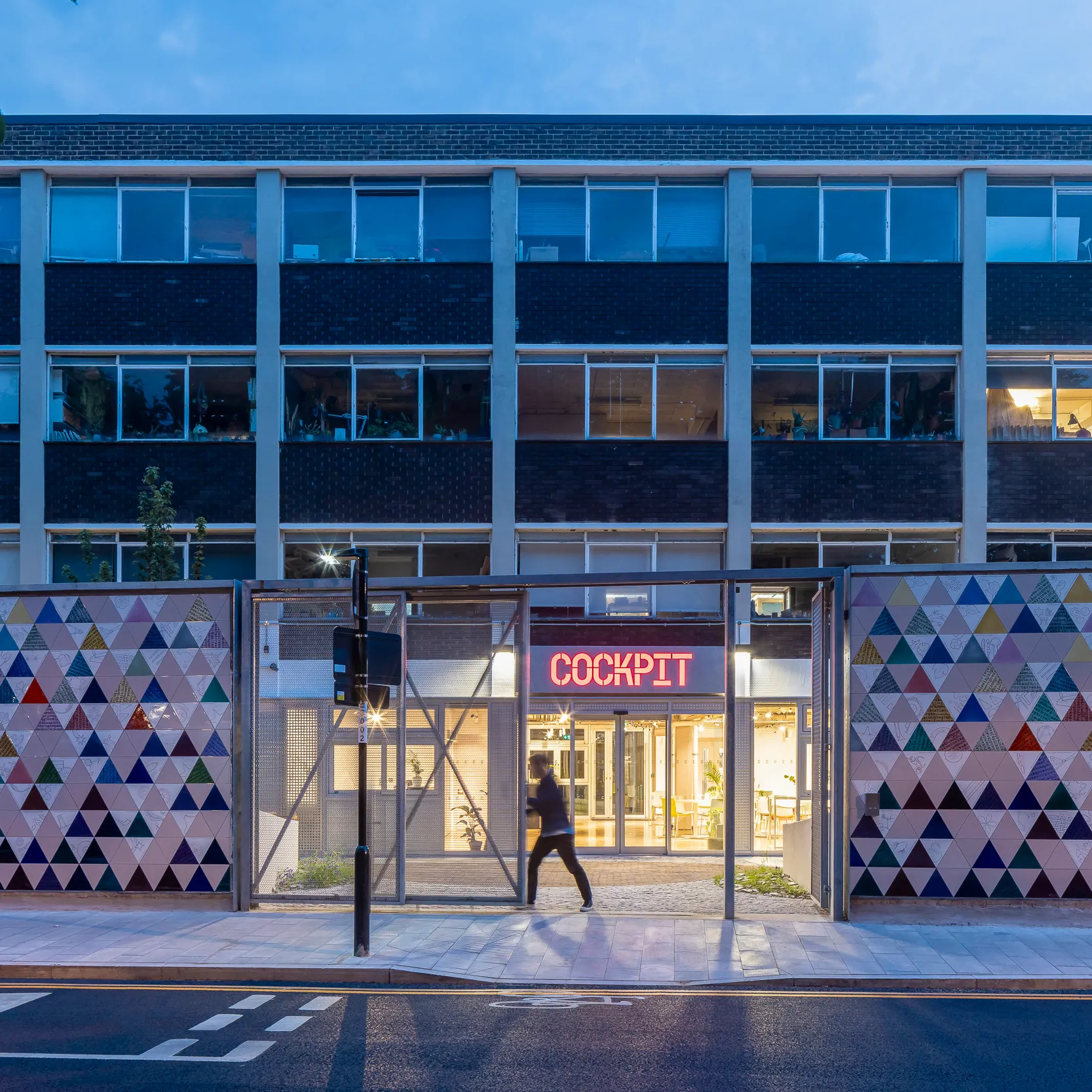
Cockpit Deptford, London Borough of Lewisham for Cockpit with Cooke Fawcett Architects, Planning Lab, Momentum, Max Fordham LLP, New Stages and Gardiner & Theobald
Cockpit Deptford transforms a 1960s former council building housing 60 craft studios, adding 20 new affordable spaces and public amenities. A 6m-wide opening in the street façade activates a previously hidden yard as a welcoming craft garden. A new timber workshop provides specialist fabrication facilities. Through thoughtful retrofit rather than demolition, the project preserves embodied carbon whilst dramatically improving environmental performance. Funded by the GLA Good Growth Fund, this transformation secures affordable creative workspace whilst opening Cockpit to the community for the first time.
Describe the context of this project, its neighbourhood and people.
Cockpit Deptford sits within Lewisham’s Creative Enterprise Zone in Deptford, an area undergoing significant change with new residential development reshaping the neighbourhood. The building, a 1960s former council office, was purchased by Cockpit in 2001 and converted into affordable studio spaces for craft makers. For over two decades, it has functioned as a creative hub, though it remained largely invisible to the surrounding community, hidden behind a forbidding brick wall.
The building continues to house Cockpit’s established community of makers, spanning diverse craft disciplines including jewellery, ceramics, textiles, leatherwork, and metalwork, and now woodwork, furniture making and stonecraft. Many makers are anchor tenants who mentor emerging practitioners, creating a supportive ecosystem for craft businesses. Cockpit’s mission extends beyond providing workspace, offering business support and fostering collaboration amongst makers who predominantly sell their work directly to consumers.
The environmental context presented both challenges and opportunities. The building’s dual east/west orientation provided excellent natural light and ventilation potential, whilst its robust concrete frame offered inherent flexibility. However, the uninsulated 1960s façade performs poorly environmentally, and the inaccessible front yard represented wasted space in an area where land is at a premium.
The retrofit responds to pressure from neighbouring development whilst seizing the opportunity to reimagine the building’s public role. Rather than being compromised by adjacent schemes, Cockpit strengthened its position by opening up to the community, transforming from an inward-facing production space into a cultural destination that welcomes visitors whilst continuing to support its established maker community with enhanced, purpose-built facilities.
Describe the intervention you’ve made including its purpose and motivation. Please explain the governance of the project, describing its viability and any consultation and community engagement undertaken.
The interventions focused on two key objectives: increasing Cockpit’s capacity to support craft businesses, and creating meaningful public engagement with making processes. The project was motivated by the need to secure Cockpit's long-term viability in a rapidly changing area whilst opening the building to the community for the first time.
The retrofit preserves the building’s 60 existing studios whilst creating 20 additional affordable maker spaces through careful reconfiguration of underutilised areas. A new 86m² purpose-built timber workshop provides specialist fabrication facilities previously unavailable at either of Cockpit’s two London sites.
The defining architectural move is a 6m-wide opening in the 21m-long, 3.5m-high street façade, transforming a previously inaccessible front yard into a welcoming craft garden. This intervention connects new public-facing amenities including education spaces, a café, and a revamped leatherworkers hub, giving Cockpit an inviting street presence for the first time.
Extensive community engagement underpinned the project’s success. From the outset, Cooke Fawcett Architects worked closely with the Cockpit team and their community of makers to identify which building qualities should inform the design. This user-led approach ensured spaces respond precisely to craft production needs whilst creating opportunities for public participation.
The project was funded through the GLA Good Growth Fund and Stride Partnership, reflecting public sector support for creative workspace. The craft garden was developed with furniture designer and ecologist Sebastian Cox, whilst local artist Amber Khokhar created a striking public art piece through collaborative workshops with community members, celebrating Deptford’s craft heritage whilst signalling the cultural activity within.
How does this project make use of an existing structure, place or building in a creative way? Is it innovative? How will this project continue to evolve or enable future flexibility and adaptation? Have you considered its resilience?
The project exemplifies creative reuse by recognising and enhancing the 1960s building’s inherent qualities. The concrete frame’s robustness and flexibility, originally designed for council office use, proves ideal for craft activities requiring varied spatial configurations and tolerance of noise, dust, and material storage. Rather than fighting the building’s industrial character, the design celebrates it through a loose retrofit approach.
The innovation lies in the strategic, minimal intervention philosophy. The dramatic 6m-wide opening in the street façade transforms the building’s relationship with its context through a single, decisive move. New elements, including Meccano-style punched metal screens, reference the site’s industrial heritage and the spirit of We Made at Cockpit.
The new timber workshop building demonstrates innovative construction by sitting on the existing car park slab, avoiding new foundations whilst providing the taller spaces directly opening onto a yard, which is ideal for woodworking. Its simple form and largely timber structure enable potential disassembly and reconfiguration in future.
Future flexibility is built in: oversized radiators accommodate eventual transition to low-temperature heating systems, supporting replacement of gas boilers with heat pumps. We are already looking at ways to add one or two storeys, and to reclad upper floors.
The design’s resilience extends beyond environmental systems. The design anticipates future nearby improvements including a “green walk” linking back to Deptford Creek alongside the viaduct. the project secures the building’s cultural value whilst its adaptable structure ensures it can accommodate evolving craft practices, changing environmental requirements, and shifting patterns of public engagement for decades to come.
Sign up to our newsletter
Get updates from The Developer straight to your inbox
Thanks to our organisation members
© Festival of Place - Tweak Ltd., 124 City Road, London, EC1V 2NX. Tel: 020 3326 7238