Get updates from The Developer straight to your inbox Yes, please!




New Watford Market, Watford for Plymouth Holdings with Makower Architects, Carson Sall Architects and Exterior Architecture
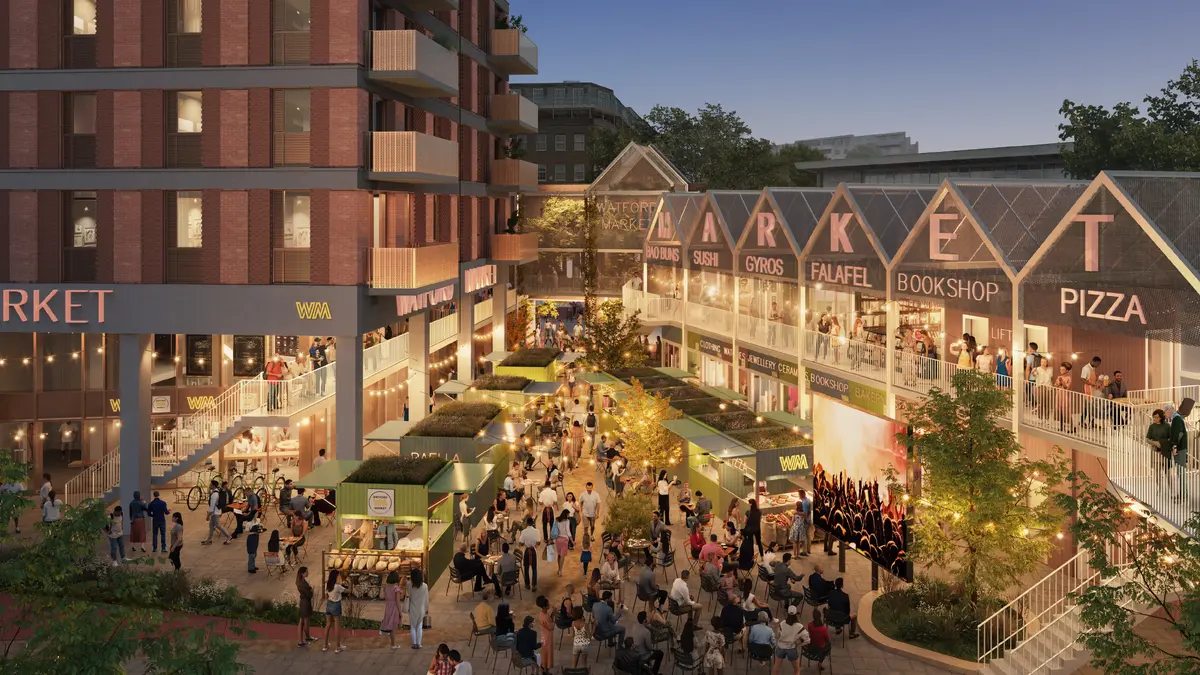
New Watford Market, Watford for Plymouth Holdings with Makower Architects, Carson Sall Architects and Exterior Architecture
A bold regeneration project revitalising Watford Market as the vibrant heart of the town. The 4,600sqm redevelopment reconnects the market area with the local community through a series of layered spaces for living, co-working and socialising. It introduces 141 new homes, each with access to green terraces and biodiverse rooftop gardens, plus flexible workspaces and community-focused facilities designed to meet the evolving needs of Watford’s residents and local businesses.
Describe the context of this project, its neighbourhood and people.
Our project sits within the centre of Watford, a growing town with a population over 100,000 and nearly 6,000 active businesses. The centre is car-dominated with little public realm. Historically, Watford has been a vibrant centre of commerce, with the market serving as a focal point for local trade since the 12th century. It is now one of the largest and busiest outdoor markets in the UK, open four days a week, with over 100 stalls and attracting thousands of visitors each week.
However, since its relocation to a back-of-house setting in 2014, the covered market, accessed near the Exchange Road overpass, has faced significant challenges. Severed by major roads, it has become disconnected from the surrounding townscape. One of which, Beechen Grove (A411) forms the Watford Gyratory, a very busy one-way road with four lanes of traffic surrounding two sides of the urban block and creating the ‘island’ nature of the site. It also suffers from poor connectivity between the rail station and the town centre, along with bad lighting, inadequate weather cover and a lack of high street presence.
Despite these constraints, Watford’s market traders have shown incredible resilience. We worked closely with them through a co-design process to create a market that meets their needs and works for the local community. Our redevelopment reconnects the market to the broader urban fabric, enhancing connectivity and creating a more welcoming environment for residents and visitors.
Please describe your approach to this future place and its mix of uses. How will it function as a vibrant place? How does it knit into, and serve the needs of, the wider area?
Watford Market has long been a cornerstone of the town’s identity. Our vision reimagines this historic site as a model for integrated town-centre living – a 24-hour destination, where living, working and leisure can coexist harmoniously via a balanced composition of residential, commercial and civic spaces, seamlessly interwoven with generous public realm.
Central to the vision is the revitalisation of Watford Market itself. Flexible retail and food spaces encourage a diverse range of traders and independent businesses, ensuring the market remains adaptable to changing community and economic needs. While a mix of vibrant indoor and outdoor spaces across multiple levels, cater to a diverse mix of people and encourage community building.
The design strengthens Watford’s connectivity and urban fabric by enhancing the market’s presence off the high street (The Parade) via a larger, more welcoming entrance, while retaining the existing façade to preserve the town’s heritage. Pedestrian permeability is enriched through enhanced routes linking The Parade, the market and surrounding streets to create stronger spatial and social connections across the town centre.
The redevelopment introduces 141 new homes, each with access to green terraces and biodiverse rooftop gardens. Complementing this are flexible workspaces, co-working hubs and community-focused facilities designed to meet the evolving needs of Watford’s residents. All of which contribute to a lively, mixed-tenure neighbourhood that supports local enterprise and sustains activity throughout the day and evening.
The result is a vibrant, future-proof place that supports Watford’s evolution as a connected and resilient town.
Please explain the governance of the project, such as its viability, purpose, motivation and any consultation and community engagement undertaken.
The governance of New Watford Market brings together multiple stakeholders with a shared vision to revitalise the town centre and foster an inclusive, resilient neighbourhood. The project is jointly driven by Watford Council, as landowner and custodian of the market, alongside a private development partner, local market traders and residents. This collaborative structure ensures that both commercial viability and community benefit remain central to the project’s delivery.
From the outset, the design and planning process has been grounded in co-design and consultation. Extensive engagement with market traders was key to defining the brief, identifying priorities such as improved connectivity, better weather protection, and stronger visual links to the high street. These insights directly shaped the architectural response, resulting in wider, well-lit entrances, enhanced public realm and flexible stall layouts that improve accessibility, visibility, and create a more welcoming environment.
The project’s viability is underpinned by its adaptable design and mixed-use programme, balancing economic sustainability with social value. Flexible spaces accommodate a spectrum of traders from open stalls to lock-up units, small retail outlets, and cafés – allowing businesses to grow and evolve within the market. This adaptability ensures long-term occupancy, diversity and economic resilience.
The motivation uniting all partners is clear: to re-establish the market as the social and economic heart of Watford, celebrating local enterprise, encouraging community interaction and providing a welcoming, sustainable destination for all.
Sign up to our newsletter
Get updates from The Developer straight to your inbox
Thanks to our organisation members
© Festival of Place - Tweak Ltd., 124 City Road, London, EC1V 2NX. Tel: 020 3326 7238