Get updates from The Developer straight to your inbox Yes, please!




Hatfield Market Place, Hatfield for Welwyn Hatfield Borough Council with dwg., BDP, Press and Starkey, and Henderson & Taylor
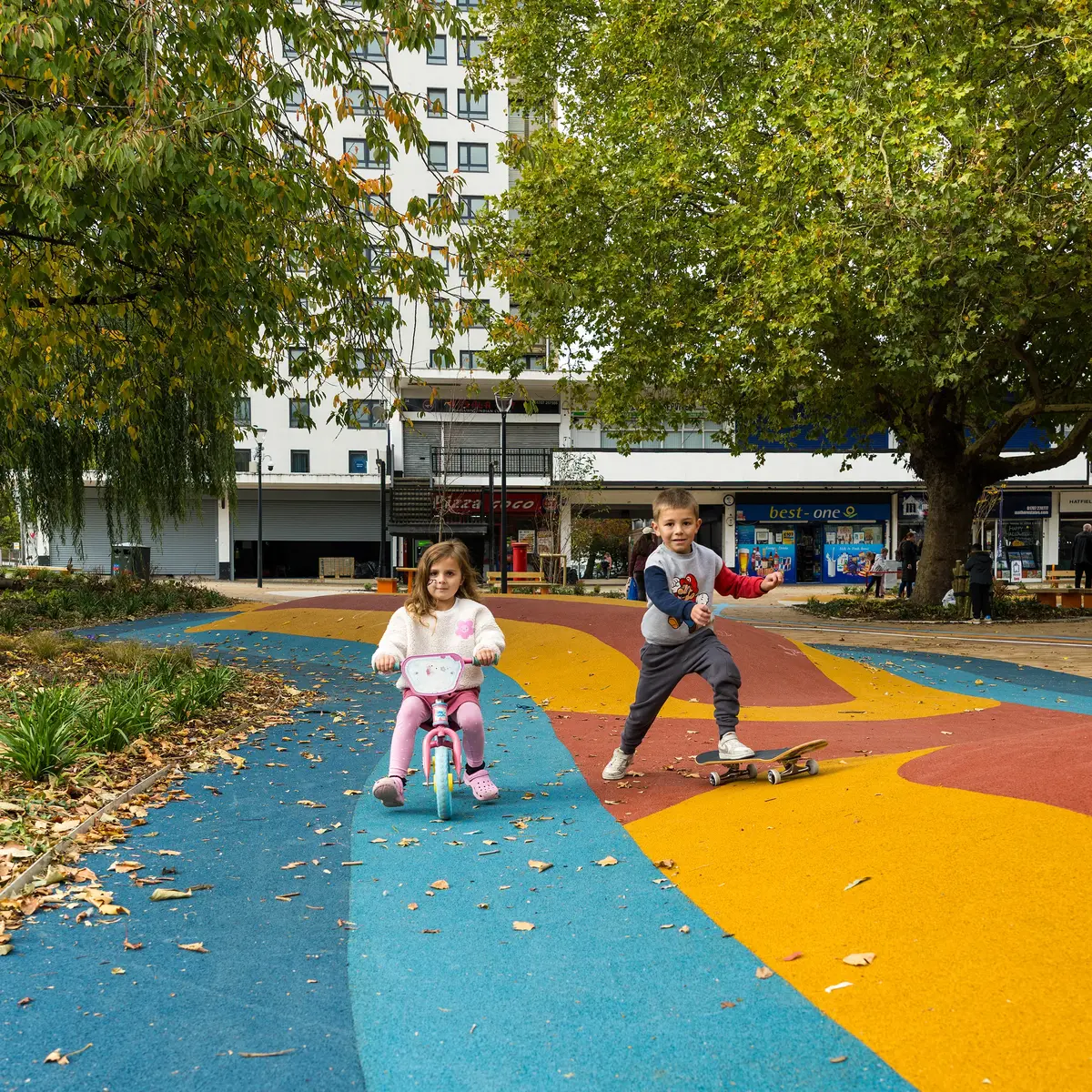
Hatfield Market Place, Hatfield for Welwyn Hatfield Borough Council with dwg., BDP, Press and Starkey, and Henderson & Taylor
Hatfield Market Place has been transformed into a vibrant, inclusive and family-friendly public space at the heart of the town. The redesigned square features step-free access, sustainable planting, integrated play for all ages and abilities, and flexible areas for markets and community events. Guided by extensive public engagement and shaped through co-creation with residents, businesses and local users, the scheme promotes social connection, biodiversity, and wellbeing - creating a lasting civic asset that reflects Hatfield’s identity, ambition, and community spirit.
Describe the context of this project and its neighbourhood and people.
Hatfield Market Place sits at the interface between the historic Old Town and the modern New Town Centre, an area shaped by post-war planning and more recent regeneration. While the square held civic and historical significance, it had become increasingly detached from the community—disconnected, inaccessible, and lacking any provision for children and families. Surrounded by residential neighbourhoods, schools and a major university campus, the area is home to a diverse, multi-generational population, including many families and young people. However, prior to intervention, the space was largely hostile to child-friendly use: fragmented levels, a lack of seating for carers, no play provision, and an environment dominated by paving and hard barriers. The project sought to completely reframe the square as an inclusive, intergenerational civic space, embedding child-friendly principles into its core. Two play zones were introduced—one with fixed equipment and one as a sensory and accessible trail—both fully integrated into the public realm rather than fenced off. The scheme also included informal social spaces, shaded seating for parents and carers, and a clear, legible layout that prioritises safety, visibility, and accessibility. The design now supports free, unstructured play and enables children to engage with the town centre in a way that fosters connection, confidence, and wellbeing. It has become a welcoming place for families to stop, linger, and participate in everyday life—marking a meaningful shift toward a child-friendly public environment in the heart of Hatfield.
Tell us what you did and how it created a child-friendly place. For example, how does it support the rights of the child to rest, relax, play and to take part in cultural and creative activities in a safe and clean environment?
The redesign of Hatfield Market Place aimed to create an inclusive, child-friendly civic space that actively encourages rest, play, and social interaction. Prior to intervention, the square lacked any provision for children and families—no play facilities, limited seating, and multiple physical and perceptual barriers to safe use.
The new scheme embedded child-centred design from the outset, following consultation with local families and carers. A strong emphasis was placed on the needs of children with Special Educational Needs (SEN), leading to the selection of play equipment and layouts that support a wide range of physical, sensory, and developmental needs. This included the creation of a sculptural play trail suitable for wheelchair users, and the integration of tactile surfaces, contrasting materials, and open visibility throughout. Two distinct play areas were created: one with fixed inclusive equipment for younger children, and another designed as a playful trail for exploration and movement, fully integrated within the landscape. These spaces are not fenced off but embedded into the civic realm, encouraging spontaneous engagement and social interaction between generations.
Nearby seating, shade, planting, and step-free access support carers and ensure the space is usable throughout the day and year. The removal of barriers and addition of high-quality lighting improves safety and comfort for all users. In doing so, the project upholds children’s rights to play, rest, and take part in community life, in a space that is clean, safe, and welcoming for all abilities.
How did the project make a positive social and environmental contribution in the context of child health childhood and wellbeing? If this was a temporary intervention, is there a legacy plan?
The redevelopment of Hatfield Market Place has made a lasting social and environmental contribution to the lives of children and families in the town. What was once a fragmented, hard-surfaced space with no child-friendly provision has been transformed into a welcoming, open, and inclusive environment where children are free to play, explore, and participate in public life.
The integration of inclusive play equipment within the public realm promotes outdoor activity, imagination, and social engagement. Features were carefully selected following consultation with local families, including those with Special Educational Needs (SEN), to ensure accessibility, sensory value, and usability for all children. As a result, children now play confidently in the heart of the town, and families describe the space as one where their children can “run, play and laugh with confidence.” Socially, the new square fosters longer visits, intergenerational use, and informal gathering. The design supports rest, relaxation, and movement, creating a setting where children are not separated from civic life, but fully included in it. Environmentally, the project achieves a 10% net gain in biodiversity through new planting and soft landscaping, alongside improved air quality, shading, and sustainable drainage. Natural materials and reused paving reinforce the town’s circular economy goals. This is a permanent public realm improvement, not a temporary intervention. It reclaims a once-neglected space and replaces it with a vibrant, accessible, multi-generational landscape - supporting the wellbeing, confidence, and freedom of children now and for years to come.
Gallery

Sign up to our newsletter
Get updates from The Developer straight to your inbox
Thanks to our organisation members
© Festival of Place - Tweak Ltd., 124 City Road, London, EC1V 2NX. Tel: 020 3326 7238