Get updates from The Developer straight to your inbox Yes, please!




Hackney Central Town Centre Strategy, London Borough of Hackney for the London Borough of Hackney with We Made That, PRD, Maayan Ashkenazi, Authentic Futures and Stockdale
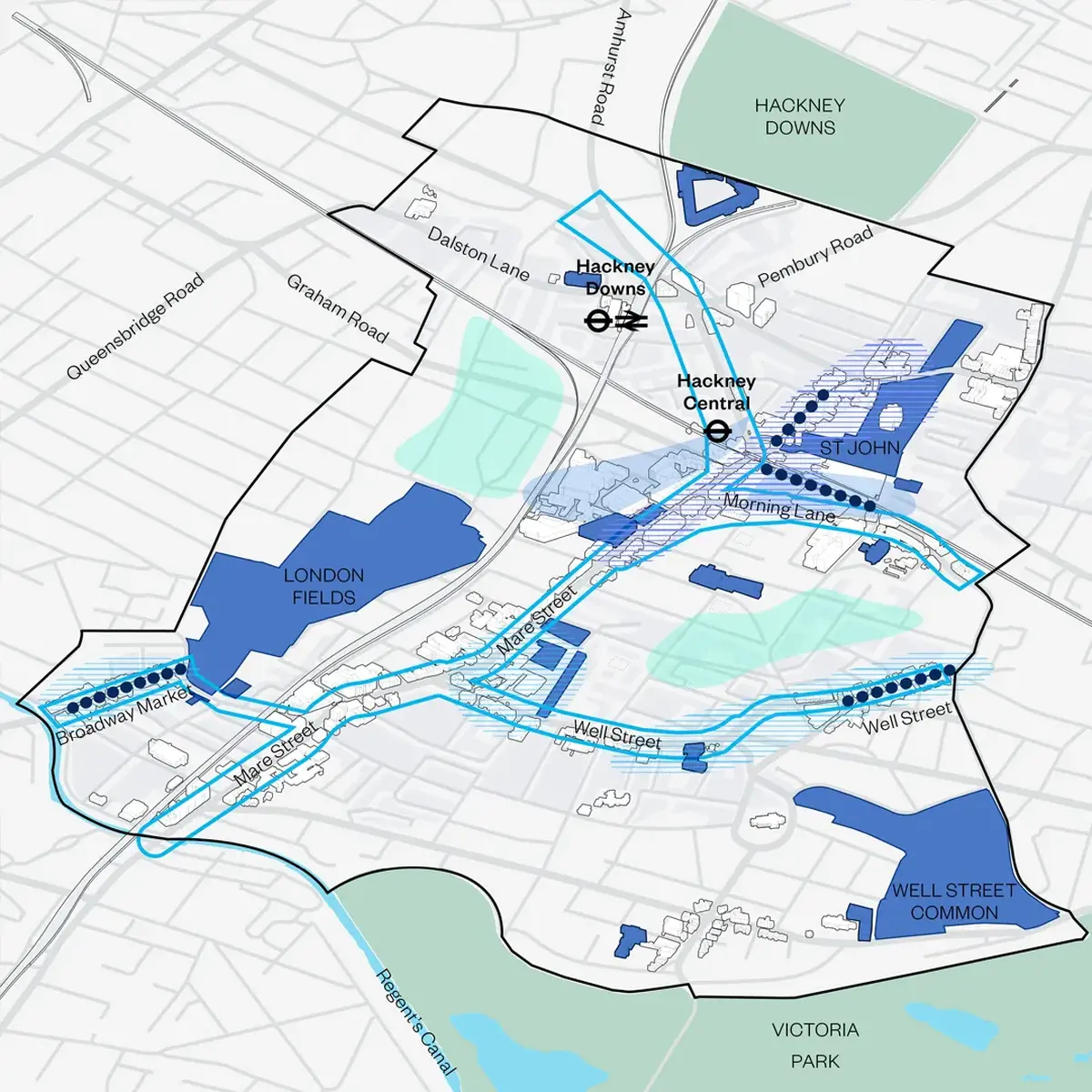
Hackney Central Town Centre Strategy, London Borough of Hackney for the London Borough of Hackney with We Made That, PRD, Maayan Ashkenazi, Authentic Futures and Stockdale
Hackney Central is changing, and through this change it’s crucial to ensure that the town centre remains a place for everyone. To make Hackney Central fairer, safer, and more sustainable, this strategy lays out a vision and delivery plan to steer the next 10 years. The process revealed that effective place-based strategies must simultaneously address inequality and climate change rather than treating them as separate challenges. The mission-oriented approach demonstrates how complex urban issues require collaborative responses that span traditional sector boundaries.
Describe the context of the strategy, research or policy. What need does it serve? What questions does it answer? What is its social and environmental impact?
The Hackney Central Town Centre Strategy recognises that Hackney is changing, and will continue to do so. The key challenge for the strategy is managing this growth, whilst also addressing entrenched inequality, ensuring that the development works harder to address the needs of Hackney’s diverse communities. With one-third of residents living in poverty and house prices fifteen times the average income, the area exemplifies tensions between economic development and social justice. The strategy responds to community concerns about displacement, rising costs, poor air quality along busy arterial routes, and limited access to genuinely affordable services.
The document establishes a framework for inclusive growth, asking how change can make Hackney Central fairer, safer and more sustainable. It addresses the disconnect between a thriving creative economy and local employment opportunities, particularly for young people who told us they feel excluded from emerging sectors.
Environmental impact centres on tackling air pollution from Mare Street’s traffic corridor and building climate resilience through sustainable drainage and green infrastructure, whilst also supporting local businesses with sustainable and circular practices.
Socially, the approach champions the area’s diverse heritage while ensuring cultural programming reflects all communities. The strategy safeguards both tangible assets and intangible heritage — from struggles for rights to food traditions — recognising that authentic placemaking must celebrate multiple histories. By tackling a broad range of both physical and social challenges with specific actions and projects, the strategy demonstrates how spatial planning can aim to tackle systemic inequalities rather than simply manage their symptoms.
Did you consult key stakeholders or the community in the creation of this document or policy? How did you select participants? Was the final strategy shared with the community? Is this engagement ongoing?
A wide programme of community engagement formed the strategy’s foundation, with over 1,500 people engaged across six months. The approach built upon the Hackney Central Conversation launched in 2019, which gathered 2,000; contributions, ensuring continuity with established community priorities.
Engagement methods were deliberately diverse to reach different demographics. Anthropologist, Mayaan Askenazi led targeted workshops with young people to capture their ambitions for their place, which resulted in a local billboard campaign of the results of their work. One-to-one conversations with community groups and organisations reached participants representing established networks, and specific business conversations engaged local employers and traders. Five co-delivered public events, designed with community partners, generated 343 comments and enabled face-to-face dialogue about the existing challenges of the area, as well as aspirations for its future.
The engagement process prioritised inclusivity, particularly targeting groups whose voices are typically under-represented in planning processes. Working alongside the Hackney Central Community Panel, comprising residents, businesses and institutions, enabled sustained dialogue throughout development. The Commonplace digital platform captured additional responses, extending reach beyond those able to attend events.
The final strategy underwent community review, with findings shared back to participants before publication. Engagement remains ongoing through the delivery programmes of specific projects, for example at 55 Morning Lane, where an in-depth engagement process for the preparation of a development brief was a specific recommendation of the strategy and is now underway.
This sustained engagement model recognises that meaningful participation requires relationship-building over time, moving beyond consultation toward genuine partnership in shaping place-based change.
How will the research or strategy be taken forward or implemented? Please describe any accountability, metrics or enforcement built into the process to encourage meaningful change.
The strategy follows a mission-oriented framework that enables collective action across public, private and community sectors. Five strategic missions break down the overarching challenge into specific, actionable areas: Champion Our Character, Wellbeing for All, A Fair Economy, Green and Resilient, and Developing Well. An accompanying delivery plan identifies concrete projects, with timeframes spanning immediate (0-2 years) to long-term (6-10 years) interventions.
Each project identifies specific Council teams, external partners, and funding sources, creating clear delivery responsibilities. The strategy document itself functions as a funding tool, providing evidence-based cases for investment. The strategy was used to support a successful bid to central government for £19m of funding to deliver its early priority projects. These included works to re-establish Town Hall Square as a focus for Hackney’s diverse communities, and changes to existing highways along Amhurst Road to reduce vehicle dominance and air pollution. These works are currently under construction.
A further development in delivery capacity is We Made That partner, Holly Lewis’s, appointment as Town Architect for Hackney Central. This role ensures design quality and community engagement principles are embedded throughout delivery, providing professional oversight that bridges strategic vision and on-ground realisation.
Accountability operates through a comprehensive monitoring framework tracking over 50 indicators, with nine identified as priorities for public reporting. These include resident satisfaction, high street vitality, crime perception, social cohesion, employment opportunities, vacancy rates, air quality, sustainable transport uptake, and community engagement with Council processes. The first round of assessment under this framework is currently underway.
Sign up to our newsletter
Get updates from The Developer straight to your inbox
Thanks to our organisation members
© Festival of Place - Tweak Ltd., 124 City Road, London, EC1V 2NX. Tel: 020 3326 7238