Get updates from The Developer straight to your inbox Yes, please!




Emma Cons Gardens, London Borough of Lambeth for The Emma Cons Gardens Trust and Lambeth Council with Farrer Huxley, Simpson Engineering TWS and Skelly & Couch
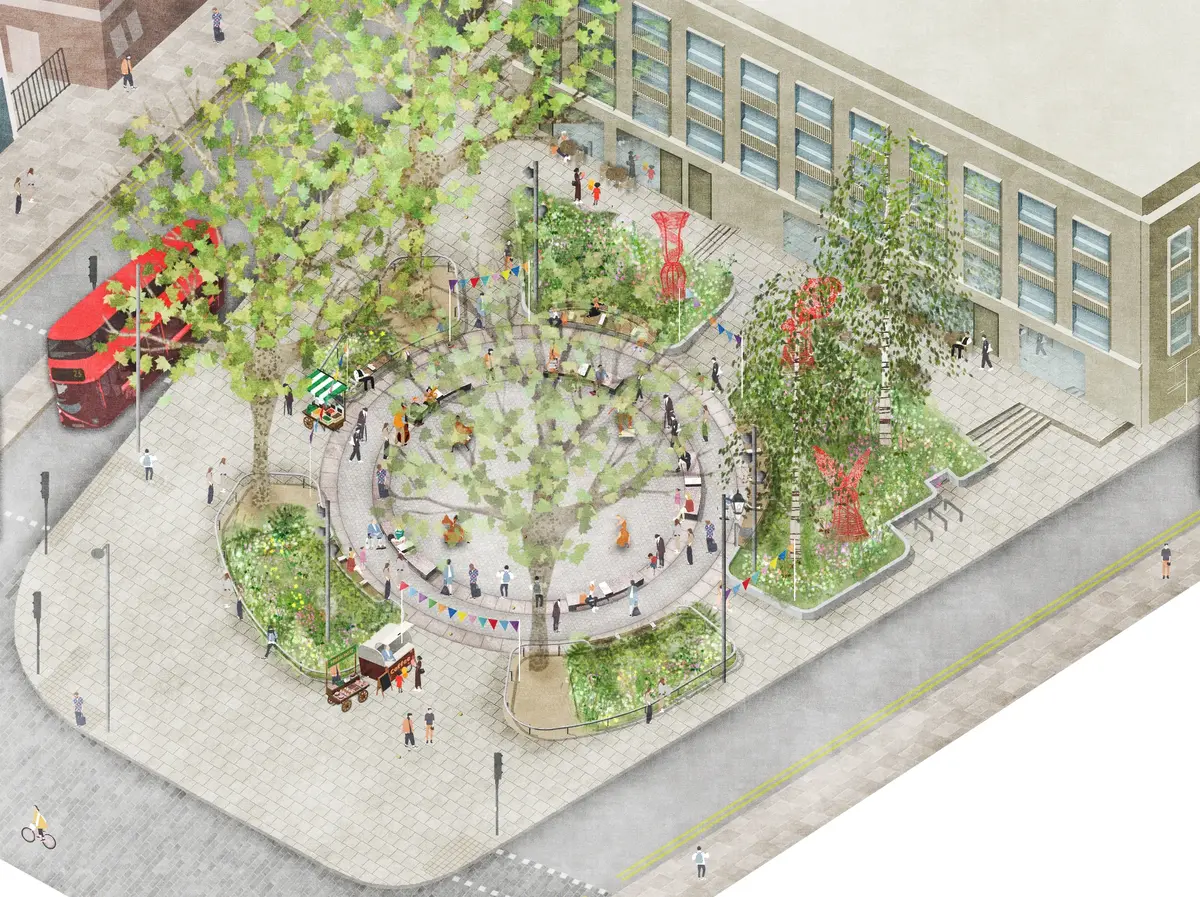
Emma Cons Gardens, London Borough of Lambeth for The Emma Cons Gardens Trust and Lambeth Council with Farrer Huxley, Simpson Engineering TWS and Skelly & Couch
Emma Cons Gardens is a well-connected but underused public space at the heart of Waterloo, close to Waterloo Station, the South Bank, and The old Vic. The proposals aim to create an inclusive, green environment that celebrates the legacy of Emma Cons by telling the stories of her life through the design. Her story is told explicitly through signage and surface detailing, and expressed atmospherically and symbolically through public art, the arrangement of the space and materials.
Describe the context of this project, its neighbourhood and people.
Emma Cons Gardens sits at the heart of Waterloo, one of London’s most culturally dense and socially diverse neighbourhoods. Within a two- to three-minute radius are The Old Vic, Morley College, St John’s Waterloo, the Leake Street Arches, major workplaces, hostels, hotels, long-standing residential communities, and some of Lambeth’s most vibrant Tenants’ and Residents’ Associations. It is a location with extraordinarily high footfall but one that has historically lacked a coherent public-realm identity.
The square and gardens function as a daily threshold: for commuters leaving Waterloo Station, for students, for theatre-goers, for families visiting the South Bank, and for vulnerable groups who use the area for safety, rest, and connection. In 2022, a renewed network of local partners—including SoWN, WeAreWaterloo, St John’s Waterloo, and local resident volunteers—formed a steering group to address a longstanding sense that the space was under-loved, under-performing, and not reflective of the cultural and social richness of the wider neighbourhood.
This project emerges directly from that community momentum. The creation of the Emma Cons Gardens Trust in 2025 formalised the collaborative effort between residents, cultural organisations, designers, businesses, and landowners (including Lambeth Council and developer Bourne Capital) to transform the space into a welcoming, safe, and culturally meaningful civic square for Waterloo.
The name of the gardens, linked to the rich heritage and legacy of Emma Cons’s life and work, provided a key driver and source of inspiration for the creation of the design brief.
Please describe your approach to this future public realm, including its purpose and motivation. How does it knit into, and serve the needs of, the wider area?
This project represents a rare opportunity to transform a neglected public space in the heart of Waterloo into one of Central London’s most vibrant and inclusive civic squares. Over the past three years, the steering group has worked closely with Farrer Huxley to develop a community-shaped vision rooted in sustainability, safety, inclusivity and cultural vibrancy.
At its core, the project celebrates the legacy of Emma Cons, a pioneering Victorian reformer whose influence shaped London’s civic and cultural life. Her story informs the design, reconnecting the gardens with Waterloo’s heritage of social progress.
The gardens express this narrative through form, materials, and detailing, while addressing practical considerations. These include enhancing the growing conditions of the mature London plane trees and maintaining key pedestrian desire lines to ensure the space is both beautiful and functional. The design creates a green sanctuary away from surrounding streets, offering flexible areas for gathering, rest, performance, and play. Opposite The Old Vic, the gardens also provide a natural spill-out area for theatre-goers and space for smaller events, pop-up markets and community activities - an approach already tested through the successful “September Thursdays” programme.
Artist Linder’s competition-winning sculptures - inspired by the Victorian bustle - serve as bold contemporary symbols of resilience, visibility and female empowerment. Forming the cultural heart of the gardens, they create a striking dialogue between past and present.
Together, these elements define a forward-looking, community-powered vision for Emma Cons Gardens - an inclusive, green and culturally resonant public space for generations to come.
Please explain the governance of the project, describing its viability and any consultation and community engagement undertaken.
Beginning with a steering group including Lambeth Council, Bourne Capital, and local community representatives, and evolving into a partnership between Lambeth Council and the Emma Cons Gardens Trust, the planning design process has been highly participatory. During three rounds of public consultation, in-person conversations, surveys, and workshops, over 400 people shared their priorities: the space should be truly public, a green oasis, a place to eat, support events, and be fun yet subtle. This was followed by community events delivered by the Trust - “Reimagining Emma Cons Gardens” - demonstrating the space’s potential. Feedback highlighted connection, local pride, and an inclusive, peaceful atmosphere. The collaborative process continued through the detailed tender stage, with three workshops with stakeholders addressing activation, placemaking, planting, and maintenance.These activities have shaped the design and future public realm, creating a vision that reflects the name and location while ensuring the space is practical, maintainable, and long-lasting.
Paul Cons, Chair of the Emma Cons Gardens Trust reflects: ‘I am a local resident, a long-standing business owner in Waterloo, and - rather wonderfully - a cousin four times removed of Emma Cons herself. With roots that deep, how could I not be part of this project? Emma Cons is one of Waterloo’s unsung heroines: a visionary whose values of creativity, social purpose, and community spirit still run through the neighbourhood. Her memory is woven into the fabric of this place, and she deserves a public space that reflects the integrity, generosity, and civic imagination she championed.’
Gallery

Sign up to our newsletter
Get updates from The Developer straight to your inbox
Thanks to our organisation members
© Festival of Place - Tweak Ltd., 124 City Road, London, EC1V 2NX. Tel: 020 3326 7238