Get updates from The Developer straight to your inbox Yes, please!




Demonstration Modular Home, London Borough's of Newham, Havering and Camden for Rollalong with Wates Residential, RCKa Architects, Design 4 Structures and HTA Design
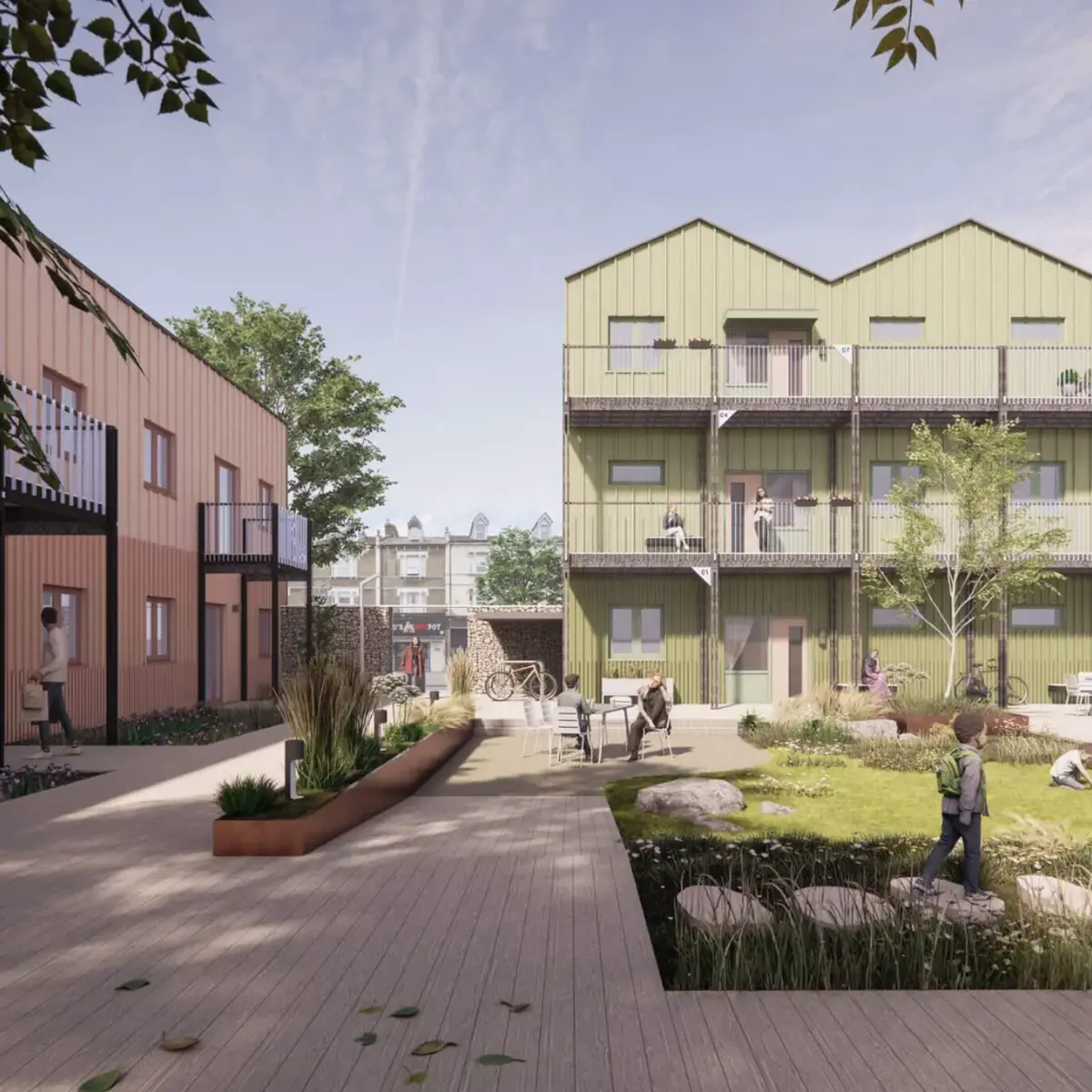
Demonstration Modular Home, London Borough’s of Newham, Havering and Camden for Rollalong with Wates Residential, RCKa Architects, Design 4 Structures and HTA Design
This Demonstration Modular Home showcases a new model for high-quality temporary accommodation in London. Developed by Rollalong with Wates Residential, RCKa Architects and Design 4 Structures, it has been exhibited at the Building Centre, Romford Market and City Hall. Formed from three standardised modules transported on regular vehicles, it meets permanent housing standards while allowing rapid delivery and future relocation. The demonstrator underpins the system now being implemented at the Waterloo Estate in Romford, offering a scalable, circular, dignified approach to the temporary housing crisis.
Describe the social and environmental context of this project, its neighbourhood and people. What is the purpose of the building? How does this building make an impact in its community?
London faces unprecedented pressure on temporary accommodation. One in 21 children lacks a permanent home, and councils spend more than £4 million a day housing families in hotels or short-term lets that fall below acceptable standards.
The Demonstration Modular Home was created to exhibit a practical and dignified alternative, enabling direct consultation with affected communities. It’s part of a range of solutions in various sizes, which breaks the paradigm of what a temporary solution can be. Developed by Rollalong in collaboration with Wates Residential, RCKa Architects, and Design 4 Structures, it provides a family-sized home that meets permanent housing standards while being deployable rapidly on underutilised land, including sites where long-term development has stalled or is subject to replanning, creating immediate social value while preserving future development flexibility.
Exhibited at the Building Centre, Romford Market and City Hall, the home allowed policymakers, residents and housing professionals to experience how modular design can deliver stable, comfortable accommodation with minimal disruption. It includes proper bedrooms, a full kitchen, bathroom, living space and generous daylight, addressing the shortcomings of hotel-based housing. Manufactured in Dorset and transported on standard-width vehicles, the system reduces logistics complexity and supports UK employment. Its circular design enables multiple redeployments across boroughs, turning temporary housing into a long-term public asset rather than a disposable expense. The Demonstration Modular Home forms the basis of the system now progressing to installation at the Waterloo Estate in Romford, where it will provide urgently needed family accommodation while Havering's wider regeneration programme continues.
Is the project innovative or creative in its design or purpose? What does it do well in terms of serving its people?
The demonstrator proves how modern construction methods deliver high-quality, relocatable housing through digitally coordinated design, factory-controlled production and strong architectural integrity. A family of standardised modules combine to create one-, two- and three-bedroom homes, with larger homes formed from four or more modules. Stackable up to five storeys, the system suits varied densities and constrained sites while maintaining consistent quality and efficient transport. A key innovation is the two-hour installation and removal time, enabling rapid deployment, use in planning consultations and a genuinely demountable solution that can be leased rather than purchased. The home was funded by private-sector partners responding to a clear need.
At 2.9 metres wide, the modules can be transported on standard vehicles without escorts, a significant benefit for London installs. Their domestic appearance, massing and window placement show how temporary homes can integrate sensitively with existing neighbourhoods. Internal layouts were refined through public feedback to create calm, generous, family-focused spaces. Manufactured in Rollalong’s factory, the modules arrive fully fitted with plug-and-play utilities and standardised foundation connections, enabling installation within hours. The demountable structure also allows straightforward disassembly and relocation. Digital design coordination by Design4Structures provides full certainty before manufacture, ensuring every element is clash-free and build-ready. The home demonstrates that temporary housing can achieve the architectural, spatial and environmental standards of permanent homes while allowing boroughs to respond flexibly to urgent need. It underpins the homes now being delivered at the Waterloo Estate.
Please describe the programme of the building, and how its design serves this use. Please also explain whether the future viability of this use has been considered. How might the building be repurposed to other uses?
The Demonstration Modular Home shows a replicable delivery model that enables local authorities to provide high-quality homes quickly while retaining long-term asset value. A typical two-bedroom layout comprises three factory-built modules totalling approximately 63 m²; a fourth module allows for four-bedroom configuration. Modules are delivered fully fitted and can be assembled on site in 2 hours, minimising disruption to surrounding communities. The system is designed for a 60-year lifespan and multiple redeployments. Its demountable foundations and robust steel frame support safe lifting and reconnection with limited ground disturbance. The 2.9m-wide modules can be transported on standard vehicles without escorts, enabling redeployment between boroughs or across London. The next implementation, at the Waterloo Estate in Romford, will place 18 homes on a site where long-term development has been paused. This demonstrates how councils can activate stalled or underused land productively while preserving its potential for future regeneration. The system gives councils flexibility to vary unit mix, adjust layouts and respond to changing demand. As a retained asset, it delivers strong financial efficiency compared with nightly-rate accommodation such as hotels. The home therefore represents not only a building, but a long-term housing strategy, providing a scalable, circular and predictable model for meeting urgent housing need.
Gallery

Sign up to our newsletter
Get updates from The Developer straight to your inbox
Thanks to our organisation members
© Festival of Place - Tweak Ltd., 124 City Road, London, EC1V 2NX. Tel: 020 3326 7238