Get updates from The Developer straight to your inbox Yes, please!




A Way Back Home - A Strategic Approach to Tackling the Temporary Housing Crisis with Temporary Modular Housing, London Borough of Havering for Wates Residential with RCKa Architects, Design 4 Structures, Rollalong, Strata, LDN collective, AY, HTA Design a
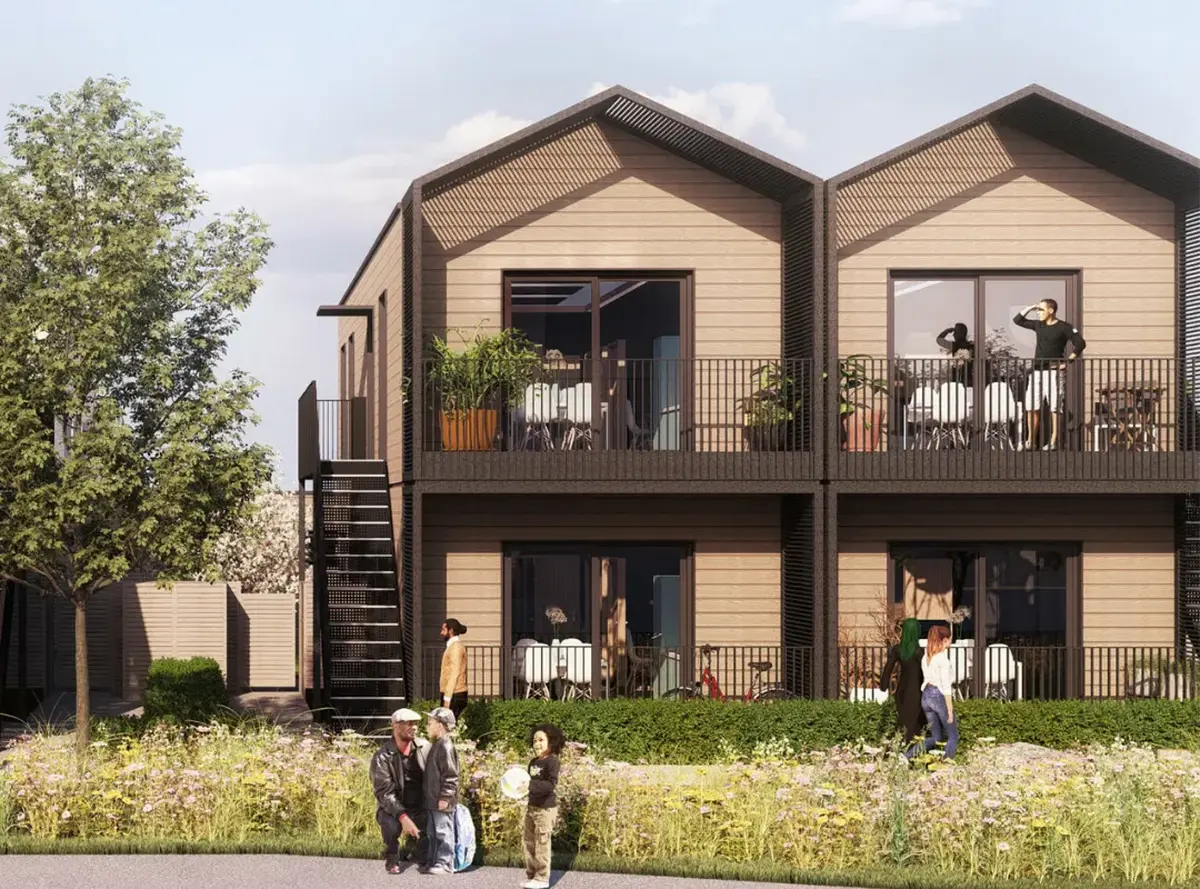
A Way Back Home - A Strategic Approach to Tackling the Temporary Housing Crisis with Temporary Modular Housing, London Borough of Havering for Wates Residential with RCKa Architects, Design 4 Structures, Rollalong, Strata, LDN collective, AY, HTA Design and Mishcon De Reya
A Way Back Home demonstrates a new strategy for tackling homelessness through relocatable, high-quality modular homes.It translates policy ambition into a deliverable, affordable and circular housing model. The demonstration, exhibited across London, provides the framework for councils to deploy energy-efficient homes within a year, achieving permanent housing standards with 40% lower embodied carbon and up to £63,500 annual savings in social cost. The first scheme to benefit is at Waterloo Queen Street in Havering, where the homes are due to be completed early 2026.
Describe the context of the strategy, research or policy. What need does it serve? What questions does it answer? What is its social and environmental impact?
The UK faces a severe temporary housing crisis. Over 130,000 households, including 169,000 children, live in insecure accommodation. Councils spend more than £5.5 million in London daily providing hotels and short-term rentals that often fail to meet basic living standards. A Way back Home was developed as a strategic, evidence-based response. Created by Wates Residential, in collaboration with Rollalong, HTA (Masterplan), Strata (PM/EA), Conisbee, Meinhardt, Avison Young, Mischon De Reya and LDN Collective it demonstrates how high-quality, relocatable modular homes can meet permanent housing standards while typically delivered in 26 weeks.
In partnership with Rollalong, RCKa and Design for Structures, the vision was realised through a demonstrator home. The system comprises three standardised module types, enabling consistent manufacture and multiple apartment configurations, including 2- and 3-bedroom layouts. Homes are designed for a 60-year lifespan and multiple relocations, giving local authorities flexibility with lease options from as short as 5 years at affordable rates.
The demonstrator home embodies a strategy rather than a standalone build, integrating design excellence, engineering precision and policy advocacy. It addresses key questions:
•How can temporary housing be delivered quickly without compromising quality?
•How can councils reduce carbon, waste and operational cost?
•How can stalled or interim sites be used productively within circular regeneration?
Supported by research within Wates Residential’s Modular Housing Playbook, A Way Back Home, the approach delivers measurable benefits: 40% embodied-carbon reduction, up to 30% delivery cost savings, EPC A performance, and potential savings of £63,500 per adult per year compared with hotel use.
Did you consult key stakeholders or the community in the creation of this document or policy? How did you select participants? Was the final strategy shared with the community? Is this engagement ongoing?
The strategy was shaped through collaboration between public, private and design partners, and refined through real-world public engagement.
The project team, worked closely with local authorities, housing officers and MMC specialists to align the system’s technical, social and operational requirements. The London Borough of Havering engaged early to test its applicability for council-led delivery and to inform adaptation for the forthcoming Waterloo Estate deployment.
A full-scale demonstrator home was manufactured and displayed publicly at the Building Centre, Romford Market, and City Hall. These exhibitions have given residents, policymakers and housing professionals the opportunity to experience the homes first-hand and provide feedback on usability, accessibility, daylight, privacy and perception.
This transparent approach helped demonstrate that temporary modular housing can achieve the same space and amenity standards as permanent homes, while offering adaptability across multiple sites. Feedback directly informed refinement of the system’s internal layouts, external appearance and interface details.
Supplementary consultation took place through Wates-led workshops with London councils and government departments, ensuring alignment with MMC policy, planning processes and funding models.
Engagement continues as the system’s first deployment prepared for installation at Waterloo & Queen Street, where in use data on cost, carbon, delivery and resident experience will support ongoing strategic development.
How will the research or strategy be taken forward or implemented? Please describe any accountability, metrics or enforcement built into the process to encourage meaningful change.
A Way back Home sets out a repeatable strategy that integrates research, design, engineering and funding solutions into one deliverable framework to support local authorities.
Implementation metrics are grounded in the home’s performance and validated supply chain:
• Speed: Typical installation of 26 weeks from first meeting to lived-in homes.
• Transport efficiency: modules are 2.9 metres wide, enabling delivery on standard vehicles with no escorts or abnormal-load logistics, lowering cost and disruption. This size also assures ultimate flexibility in future re deployment
• Carbon: approximately 40% lower embodied carbon than traditional methods.
• Cost: Up to 30% reduction in delivery cost; 90% less on-site waste.
• Design certainty: 100% clash-free digital coordination by Design 4 Structures.
• Quality assurance: BOPAS certification.
The system’s demountable foundations and robust steel frame support multiple relocations over its 60-year design life, allowing long-term asset value and relocate homes as demand changes.
The governance model is flexible: councils can lease or retain asset ownership, performance data is traceable through each deployment, and digital models ensure accurate lifecycle reporting.
The strategy is now being implemented at Waterloo & Queen Street, providing the first multi-home application of the system. This live deployment forms a key part of the accountability cycle, measuring outcomes against economic and environmental benchmarks. The saving against hotels and hostels is significant, but more importantly the quality of accommodation is a real change to some of the poor options that councils are having to rely on at present.
Sign up to our newsletter
Get updates from The Developer straight to your inbox
Thanks to our organisation members
© Festival of Place - Tweak Ltd., 124 City Road, London, EC1V 2NX. Tel: 020 3326 7238